
Thursday, 9 January 2014
Detective Comics #27 Review

Manifest Destiny #3 Review (Chris Dingess, Matthew Roberts)

Black Widow #1 Review (Nathan Edmondson, Phil Noto)

All-New Marvel NOW! Point One #1 Review
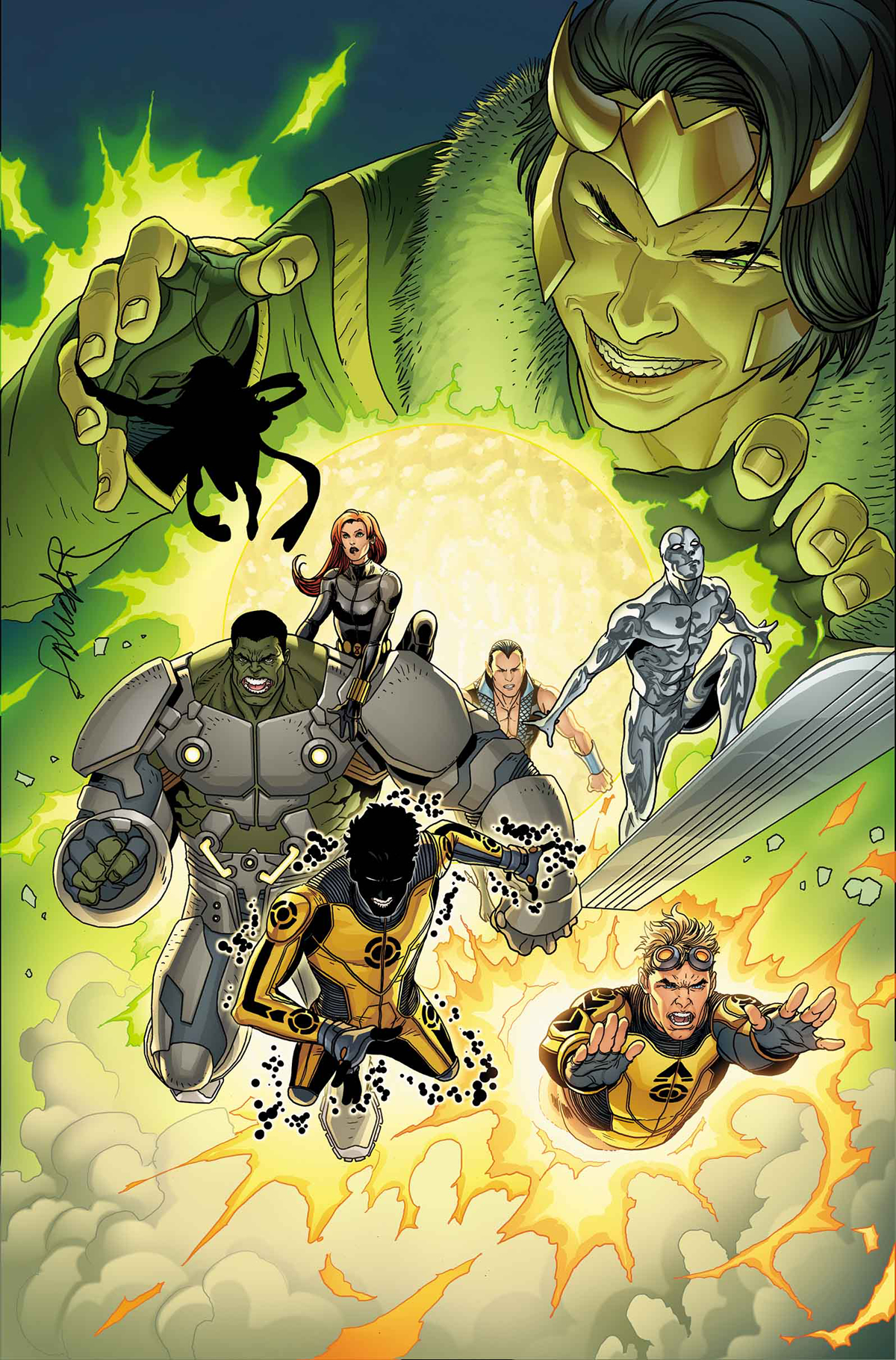
Read my review of All-New Marvel NOW! Point One #1 here: http://whatculture.com/comics/8-awesome-comics-must-read-week-8-january.php/3
Scooby-Doo Team-Up #2 Review (Sholly Fisch, Dario Brizuela)

Read my review of Scooby-Doo Team-Up #2 here: http://whatculture.com/comics/8-awesome-comics-must-read-week-8-january.php/2
Comics of the week (8 January 2014) + comics news!
Wednesday, 8 January 2014
Most Anticipated Comics of 2014

I take a look at the year's most anticipated comics here: http://whatculture.com/comics/10-anticipated-comics-2014
Tuesday, 7 January 2014
Stoner by John Williams Review

Stoner is a novel that is so overbearingly bleak that, before you’re even halfway through, you want to put the book on suicide watch.
In the same breath, you can’t stop reading it and not in the sense that you can’t avert your eyes from a train wreck but because it is a really good novel, well written, and surprisingly captivating given the academic subject matter.
Born in late 19th century America, William Stoner grows up on his parents’ farm, an only child, and goes to the University of Missouri to study agriculture. There, he falls in love with literature, and becomes a Professor of Literature at the University for the rest of his life. As the major events of the 20th century occur around him – World War 1, Prohibition, the Wall St Crash, the Great Depression and World War 2 – he mistakenly marries a cold woman but remains her husband until his death, they have a child together, he has an affair, and he eventually dies of cancer.
It’s a very straightforward story. John Williams chronicles the outwardly unremarkable life of Bill Stoner with an elegance and wisdom rarely seen in fiction and then only in the acknowledged classic writers like Fitzgerald, Hemingway or Steinbeck. This campus novel and Stoner’s life is tackled in a linear way with no fancy literary tricks or ideas, just a steady, subtle storytelling way and it’s his inner life and thoughts that are so compelling and original.
But it’s definitely depressing!
Stoner’s parents are stoical farmers, grimly going about their lives, rarely smiling or speaking to their son. Stoner goes to university and makes just two friends, one of whom dies in France during WW1! The first woman Stoner falls for is Edith, an upper-middle class ice queen whom he marries. Their courtship is awkward and rigid, their honeymoon is cringe-worthy and sad – Stoner attempts to make things better by getting some champagne for them and even then the concierge is miserable, muttering that it’s not good champagne! His new wife views sex as practically akin to medieval torture. This guy cannot get a break and we’re not even past the first 100 pages!
It became so unrelentingly downbeat that it became funny to me. Stoner’s parents die within a few pages of each other, his father-in-law commits suicide a few pages later – as I was reading this chapter I was laughing at unbearable sadness. Of course! More death, more melancholy! I was surprised the mother-in-law didn’t die or Stoner didn’t watch a kitten get beaten to death by some townies!
I won’t detail every single personal tragedy of Stoner’s but suffice it to say that in a 290 page novel, a mere 20 pages are given over to Stoner finding any happiness at all, in the arms of another woman – who of course has to leave his life forever to avoid scandal, returning him to his state of despair!
But here’s the thing – even though I found the tone of the book to be one of misery, and it is a prominent feature of the book, to dismiss it as a morbid piece of literature is too reductive and easy. I saw a review of Stoner that simply said “Life sucks and then you die”, but it’s much more than that. If it was just depressing, I wouldn’t have been compelled to keep reading like I was.
In some ways, Stoner could be argued to be the story of a content man – Stoner does the job he most wants, teaching literature; he has just one friend but at least he has a friend and a true one at that; he experiences real love (albeit briefly); and he has many moments of happiness with his daughter Grace. And there’s the other aspect of the book – the celebration of learning. This is a novel about an academic, and about academia, and the rewards of study, learning and teaching – and Stoner is a good teacher.
Yet even if the subject could be dry and tedious in the wrong hands, Williams manages to find a vitality and edge to it, possibly due to his also being an academic at the University of Denver in real life. The hearing scene where a panel, upon which Stoner sits, cross-examines a graduate student who believes he has been unfairly failed by Stoner is absolutely riveting and yet all that’s happening is a snotty self-entitled student complaining to a group of teachers and administrators about a teacher. The scene goes on for a lengthy chapter but the pages fly by. And the pages where Stoner falls in love with a female graduate student and the two have a whirlwind romance, is utterly convincing and real.
Damn, I’ve done it again: written too much in my review! Ok, broad strokes – the characterisation for the most part is perfect though I was never totally convinced of Edith’s enmity toward Stoner. Their horrible marriage felt real but for Edith to turn on her husband so desperately was a bit odd – though the way she turns on him by using their daughter against him is heart-breaking. And this is a massive point in favour of this novel: it makes you feel things.
More often than not a book engages your mind and you can enjoy it on an intellectual level, maybe it even makes you laugh, sometimes you’re bored with it, and sometimes you’re annoyed with it. It’s rare that a book hooks the brain and the heart at once in such a way that the brain is yearning for more while the heart is waving a white flag of surrender while weeping silently. Stoner is a novel with a powerful emotional punch you can’t avoid. Most of us read to escape reality; Williams describes reading Stoner as an escape to reality (and a pretty grim one at that!). But, having read John McGahern’s introduction, I liked that Williams shares my own philosophy of literature: reading without enjoyment is worthless, so make reading enjoyable – and he did!
Finally, I picked this book up on a whim, having read about Stoner being published in 1965 and not finding an audience for several decades until a new French translation in 2011 turned it into a bestseller in France. Since then it’s sold hundreds of thousands of copies in Holland, Italy and the UK, is taking off in Germany and is about to launch in China. John Williams died in 1994 but his widow is still alive so it’s wonderful that she’s able to receive the royalties of her husband’s work and that Williams has finally been acknowledged as a notable writer of the 20th century. All of these things pushed me to pick up Stoner and I’m so glad I did. It really is an American classic and a brilliant novel.
I could write more about the quality of the prose but Williams says it best in the novel itself as Stoner reads the book written by the love of his life and thinks:
“The prose was graceful, and it’s passion was masked by a coolness and clarity of intelligence.” p.259
Stoner

Sunday, 5 January 2014
The Last Christmas Review (Gerry Duggan, Brian Posehn, Rick Remender)

The Last Christmas is one of those lazy books that takes a universal story, like fairy tales, and subverts the popular image, giving a new slant on them where the bad characters tell their side of the story and it turns out the good guys are bad, and so on. This book turns Santa from a jolly old fat man into a wannabe child-murdering drunk. By the way, that’s the only joke in the story and it’s repeated throughout so even if you laughed the first time, it gets less funnier the more its used.
The zombie apocalypse is brought about when mankind blows up the world with nukes and in the aftermath, some Mad Max-esque marauders make it up to the North Pole one Christmas when Santa’s out and about and rape/murder Mrs Claus. Santa returns and loses his mind. He gives up on Christmas, choosing to drink himself into a stupor until he attempts suicide - unsuccessfully. Because despite the decimation of the human population, one young boy still believes in Santa and so long as he lives, so does Santa - so Santa sets off in his sleigh to kill the boy and thereby kill himself. Ho ho…. oh no. Yeah it’s pretty grim.
This forgettable comic from 2006 has been reissued thanks to the popularity of Gerry Duggan and Brian Posehn’s work on Marvel’s Deadpool series, and Rick Remender’s rise in the comics world too though as a writer. Trying to make a quick buck - always the best reason to bring stuff back, right? They’ve even got Geof Darrow to draw a new cover for it, like the cover he drew to Duggan/Posehn’s first Deadpool book (to be fair, it is an awesome cover).
Like I said, it’s a one joke book where everything you expect about Christmas and the characters are subverted - Santa’s a drunk who pisses and pukes on himself and wants to die, the elves make guns instead of toys, Frosty the Snowman is a narrator/‘Nam vet character, and so on. The whacky humour isn’t as funny as it is in Deadpool with the writers instead choosing to reference and borrow heavily from pop culture so it reads like every zombie story. The marauders storyline makes no sense, and everything feels extremely derivative and uninteresting. Get past the setup and you’re left with the shallowest of stories: Santa kills zombies with a machine gun. Yawn.
Remender’s art isn’t bad and it’s cartoony style suits the crazy story well, though his character model for the hot woman is so unrealistic it would make Barbie roll her eyes. I’m sure that choice was deliberate but it only makes the comic that much more cheesy. And his child characters don’t look like kids, at least facially. The kids’ faces look much older so rather than look like kids, they look like little people instead.
The only part I laughed was the letter from Mrs Claus that preceded the comic which outright insults all of the creators on the book, which was probably written by the creators, and, in its vitriol, was much more entertaining. Without visual images to assist, more effort has gone into the writing of the letter than the writing in the comic itself as that writing can rely on visual aids to do half the work.
Otherwise, The Last Christmas is an unfunny story filled with unlikeabe, uninteresting characters on a moronic journey through hell. It goes from bad farce to bad comedy to the schlockiest of zombie and action movie cliches. I’m certain this was a booze/weed-fuelled idea that sounded great when they were out of it but simply isn’t interesting enough to sustain a 150 page book. I like the creative team’s other efforts but The Last Christmas is pretty bad.
The Last Christmas

Friday, 3 January 2014
Room For Love by ILYA Review

Pamela Green is a romance novelist who no longer wants to write romance. She doesn’t believe in it, she doesn’t feel it, and she certainly has none in her life. Single, divorced in her forties and living alone in a large, empty house with a cat who’s recently run off, she doesn’t know what she wants or where she’s going - until she happens across a young man called Cougar whom she believes is about to commit suicide by jumping off of a bridge. She doesn’t realise until the police drag him out that he’s been living rough under the bridge and, feeling guilty, she impulsively asks him to come home and stay with her. So begins an unlikely relationship between a lonely middle-aged woman and an equally lonely teenage runaway in Ilya’s superb new graphic novel, Room For Love.
If you thought because of the title that this was a romance comic, the tone of the book is set within the first few panels: Cougar is a prostitute, trading sex to hitch-hike to London. His life is as unromantic as it gets: getting kicked awake by police after sleeping in a doorway, begging on streets before becoming friends with another young male prostitute. When they’re not turning tricks in side streets, they’re sitting in cinemas running classic horror marathons because they’ve got nowhere else to go - the almost cartoonish horror of the Hammer films is cruelly juxtaposed with the real horror of homelessness on the streets of London and, later on, the awful fate of Cougar’s friend. This isn’t an overtly polemical book, though it does seek to portray truthfully the real situations its characters would encounter, and often these situations are quite dire.
Compared to Cougar, Pamela’s life troubles are almost comical yet distinctly middle-class. She wants to give up writing popular romance novels under her pseudonym, Leonie Hart, and gain some credibility by writing something more substantial and less derivative. At the advice of her publicist and best friend Germaine, she tries dating in an effort to get out of her rut, but, as anyone who’s tried online dating will tell you, the dates are awkward at best. And then she meets Cougar.
Room For Love is a great book, a masterpiece even, because of its character-driven story. Ilya effortlessly brings to life two disparate characters and their worlds vividly and merges the two without making it seem forced or false. The characters behave as you would expect based on their different socio-economic backgrounds and their interactions feel real and convincing, while also being charmingly offbeat like when Pamela is talking about the Iliad to Cougar. Ilya also represents this visually by colouring Pamela’s panels blue and Cougar’s panels orange. As the two slowly get to know each other, their distinct colours soften and merge until the scenes between the two are a combination of the two, a muted copper colour.
Ilya tells his story without an overt narrator - the reader is never told the inner thoughts of either Pamela or Cougar from anyone other than the characters, and even then only sparingly, and there is no narrative voice intruding in boxes to set the scene. We primarily experience the story through the characters’ actions, their expressions, and the way they interact with one another. It’s a beautifully subtle and utterly masterful way of telling a story that shows the high level of sophistication Ilya has achieved as a comics storyteller.
There is a wonderfully layered story to be found in Room For Love. Like the title’s many interpretations - literal, metaphorical, a description of their situation - the story discusses the many types of love first codified by the Ancient Greeks and which we all experience. Human love being so abstract and complex it’s not simply just one person caring for another, there are many varieties of love like friendship love, family love, romantic love, love of the self; all types of love that are worked into the story. Pamela and Cougar’s difficult relationship is alternately made up of different kinds of love and, true to the way he handles the rest of the story, Ilya avoids giving either character a predictable, pat ending. Real lives do not have arcs and while these characters seemingly change in small ways throughout, they are ultimately themselves at the end, still with problems and still with struggle ahead - but with renewed hope.
As artistic as the comic is, it’s a book anyone looking to read a good story, whether you read comics or not, can pick up and be unfailingly moved by. Its story is unique because the characters are the story and they only exist in this book, and their story is an absolutely engrossing one. Ilya has created one of the most enthralling, heartfelt and outright brilliant comics of the year in Room For Love.
Room for Love

Bloodshot Volume 4: H.A.R.D. Corps Review (Christos Gage, Joshua Dysart)

Bloodshot has been captured by Toyo Harada, the powerful head psychic of the Harbinger Foundation, who wants to extract the nanites that make Bloodshot near invulnerable with their rapid healing. Enter the HARD Corps, a team of humans whose brains have been modified to give them temporary superhuman powers and who have been assembled to rescue Bloodshot – but will such an inexperienced team be able to stand up to Harada, one of the world’s most dangerous men?
The short answer is yes (though just barely). It’s also an entertaining rescue mission story that bizarrely winds up repeating itself like in the original Star Wars Trilogy when they blow up the Death Star twice! Unlike Star Wars though, it’s difficult to like any of the characters.
In the Bloodshot #0 issue, Bloodshot murders a mother and her baby on one page, then massacres a family picnicking on a beach on the next, because he doesn’t want any witnesses – this is our hero by the way! The HARD Corps meanwhile are made up of desperate people who’re essentially giving up their lives for their families’ future financial security. The system has screwed them so badly that having experimental implants stuck in their brains is their only recourse. HARD Corps (what a stupid acronym! It exists solely as a pun on “hardcore”) version 2 are made up of homeless drunks, the terminally ill, and a Flowers for Algernon guy – all doomed! These are also our heroes! Meanwhile the bad guy, Harada, is extracting Bloodshot’s nanites to help cure humanity’s incurable diseases to benefit our race – and he’s our villain.
Besides the confusing allegiances readers may have about the characters and their situations, it’s not a bad comic. The HARD Corps bust into Harbinger HQ to rescue Bloodshot in an exciting and fun sequence, then go back again – this time with Bloodshot – to recapture what nanites Harada was able to extract, and that sequence is also pretty cool. The characters themselves aren’t that interesting personality-wise and they have terrible codenames like Superstar and Genius, but their brain implants which give them temporary superpowers are an awesome idea and seeing a team of amateurs using them without the smooth panache that superheroes like the X-Men use their powers, is a compelling angle. Unpredictability in action can be very fun like it is here.
There are plenty of dull dialogue scenes between the leader of the HARD Corps, Charlie Palmer (who isn’t as cool or interesting as his almost namesake, Chili Palmer, the Elmore Leonard character), as corporate guys in suits argue with military monkeys in a series of repetitive pissing matches. But then this is a Christos Gage comic – the guy isn’t known for his great writing – and Joshua Dysart is average at best. The art is so-so but not particularly memorable.
There isn’t much else to this volume and for all its numerous inclusions of brains throughout, this comic is as brainless as it gets. It’s not a layered read, it isn’t very complex nor does it have any clever or profound observations – it’s just the Valiant version of the Expendables. And like those movies, Bloodshot and HARD Corps does hold the attention, though only in the action parts.
Bloodshot Volume 4: H.A.R.D. Corps

Top 5 Superhero Deaths of 2013!

Read my article on the top 5 comic book superhero deaths of 2013 here: http://whatculture.com/comics/5-notable-superhero-deaths-2013
Superman Unchained #5 Review (Scott Snyder, Jim Lee)

Thursday, 2 January 2014
Guardians of the Galaxy #10 Review (Brian Michael Bendis, Kevin Maguire)

Subscribe to:
Posts (Atom)