Opening with Philip K. Dick seeing early footage from Ridley Scott’s Blade Runner shortly before his death in 1982, Laurent Queyssi and Mauro Marchesi’s Philip K. Dick: A Comics Biography is a fine overview of one of the most original and notable writers of the 20th century.
Copkiller. American Robin Hood. World-famous outlaw. Western legend. This is the story of William H. Bonney aka Billy the Kid, infamous for the murders of several lawmen and shot dead by federal agents in 1881 aged just 21 years old.
Sartre is a really crappy biographical comic on the major twentieth century French philosopher, Jean-Paul Sartre. Writer Mathilde Ramadier does a remarkably substandard job of explaining the philosophy of existentialism, which Sartre was most famous for, as well as failing to highlight what made him notable to the wider public in the first place. We just get a truncated overview of his (seemingly) uneventful life from bookish youth to teacher to - suddenly! - intellectual celebrity.
On the morning of January 15th, 1947 in Los Angeles, a woman and her daughter walking past a vacant lot saw what looked to be a discarded mannequin but were actually the remains of 22 year old Elizabeth Short. She had been mutilated; her body cut in half and cleaned, before being dumped in the lot. Because of her striking appearance, the murder victim would become known as the Black Dahlia, one of LA’s most famous and unsolved killings - this is her story.
Rick Geary takes a break from his brilliant Treasury of Victorian/20th Century Murders series for a work of fiction starring the real-life Golden Age of Hollywood actress, Louise Brooks. Brooks was more famous for popularising the bob haircut than her acting though she had some movie success in the 1930s. However by 1940, when this comic begins, she’d done some European films and returned to find Hollywood was no longer interested in her.
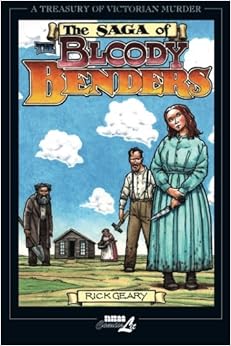
The “bloody” Benders were a small German immigrant family who settled in late 19th century Kansas, opened a grocery store/inn and began murdering rich lodgers and stashing the bodies across the prairie and in a ditch beneath the house.
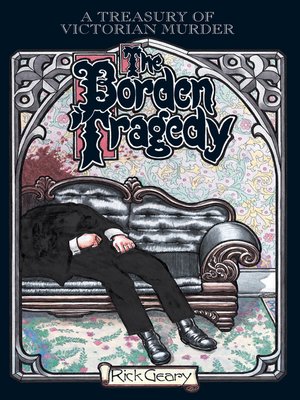
On August 4 1892, the bodies of Mr and Mrs Borden were found brutally murdered in their home in Fall River, Massachusetts . Also in their house were Mr Borden's daughter Lizzie and their servant, Bridget Sullivan. Mrs Borden (Lizzie’s stepmother) was murdered first in her bedroom and then approximately 2 hours later Mr Borden was murdered in the sitting room. Both murders were carried out by a hatchet. Both Lizzie and Bridget were shocked at the murders but claimed not to have heard or seen anything to indicate a murderer. Lizzie was the prime and only real suspect in the case and was arrested.
Set in mid-19th century Glasgow, Madeleine Smith, a well-to-do young woman, embarks on an affair with a young man of lower class. When she becomes engaged to a wealthy older man, she breaks off the affair. Afraid that the affair will come to light, its suggested, she kills her former lover by serving him hot chocolate laced with enough arsenic to fell 40 men.
After his death, she is arrested, tried, and found not guilty. She might have done it but then her former lover had a dramatic side and had attempted suicide before - maybe this time he succeeded? After the trial she moves to London and then later New York where she dies. The end.
That was it?! I expected Geary to throw a curveball into the story to explain why he'd chosen such a bland, uninteresting case to explore in his otherwise excellent series. But no, nothing, that really is the whole story unfortunately: she might have poisoned one man or she might not have. In the end, you don't really care.
The book is taken up with the mundane life stories of Madeleine Smith and her lover Emile L'Angier, and we're forced to read the lovenotes of the usual calibre of the lovesick "I miss you" "I love you" blah blah blah. This was the first book in Geary’s Victorian Murder series where I was counting the pages til the end.
When you look back at the trumphs Rick Geary has produced in his series like The Beast of Chicago where H H Holmes has his sick hotel of death and scores of victims, or the assassination of Abe Lincoln by John Wilkes Booth and a major turning point in American history as a result, you have to wonder why Madeleine Smith, an unknown “possible” murderess, was included in the roster at all.
Do give this book a miss. Do check out the other books in Geary's excellent series.
A Treasury of Victorian Murder: The Case of Madeleine Smith
On July 2, 1881, President James Garfield, whose term has just begun a mere 4 months earlier, was shot in the back by a delusional religious fanatic called Charles Guiteau. 2 months later Garfield would succumb to the bullet wound and shortly after Guiteau would be hanged.
The assassination took place just 16 years after Lincoln's death in Ford's Theatre and the details in Garfield's case pointed to the same mistakes that allowed Lincoln to be assassinated. Garfield had no escort, he walked about Washington D.C. by himself, unguarded. Guiteau even followed him on a couple of occasions - this is the President of the United States of America we’re talking about!!
On the fateful day, Garfield was taking the train for his holidays, walked through the waiting room with one of his ministers and his two sons, allowing Guiteau free access to stand up from one of the waiting room seats and shoot him as he passed. Amazingly it would take a third Presidential assassination - that of William McKinley in 1901 - for Congress to give the President an official guard, the Secret Service.
Geary tells the story in an unusual way by comparing the lives of Garfield and Guiteau. Showing where one had a strong will to study and for hard work, and the other didn't, how people (in his eyes) are made either great or not. The story here isn't as compelling as Geary's other book on Lincoln's assassination with the background being less desperate and the assassin Guiteau acting alone on his own bizarre ideas rather than for a larger cause. He was a deeply religious man who believed “the Deity" had told him to kill Garfield and somehow believed this act would lead to a consulship in Paris. Strangely, it didn't.
The other interesting point is the lack of medical knowledge at this time. The many doctors who attended the President didn't think to operate to try and remove the bullet, nor knew how, and in fact, due to their many odd choices, made the President's injuries worse.
The Fatal Bullet is a compelling story, and Rick Geary has written another strong addition to the Treasury of Victorian Murder series - though perhaps it's not the best place to start. I'd recommend the book on Lincoln for a better Presidential assassination tale.
The Fatal Bullet: The Assassination of President James A. Garfield
On April 14, 1865 Abraham Lincoln, along with his wife and some guests, went to Ford's Theatre in New York to see the play Our American Cousin and was shot in the head by John Wilkes Booth, an actor and Confederate. Booth shouted "Sic Semper Tyrannis" or "Thus Always to Tyrants" after leaping from the balcony, breaking his foot in the jump, and escaping. Lincoln died shortly after and a few days later Booth was found and shot by Federal Marshals.
That was all I knew of the most famous assassination in 19th century history before I read this book (I’m British so that’s allowed!). What I found out was fascinating. Booth's assassination was part of a larger conspiracy where other members of Lincoln's administration would be murdered that night, such as Andrew Johnson the Vice President (and later of course President when his assassination attempt was thwarted) and William Seward, the Secretary of State.
Though the men sent to kill William Seward got in, they only managed to cut the man's face before being hauled off. Seward survived while his assassin fled only to be caught later. The man who was charged with murdering Andrew Johnson lost his nerve and went from bar to bar drinking instead. Later he too was caught and all of the conspirators were hanged.
I was amazed at the lack of security given to Lincoln. Nowadays we see Presidents and heads of state having phalanxes of bodyguards, snipers on rooftops, armed motorcades and choppers. Lincoln was receiving death threats daily and had only a single bodyguard! Not only that but on the night of the murder his bodyguard was at the bar drinking instead of guarding the President!
I always imagined Booth sneaking into Lincoln's balcony secretly and then shooting him but apparently all Booth had to do was show his ID to Lincoln's PA, a man called Forbes who sat on a chair outside the balcony, to say he was an actor at the theatre (which he was) and then wait.
Booth chose the moment in the play when a joke is uttered that gets a big laugh and then took out his single shot Derringer and shot Lincoln. It's amazing that after this, he leapt down, broke his leg, and STILL managed to get away! The freakin’ theatre had no security either!
Rick Geary also mentions how Booth earlier in the day had ridden right up to General Grant's carriage and stared in, twice, at Grant and his wife, before riding off. Nobody at this time - nobody! - had thought that needing any security might be necessary. It's astonishing how at such a turbulent time, such an important figure like Lincoln could be quite so cavalier in his lack of self protection.
Geary once again produces a mesmerising true crime book that’s well-written that contains a mounting sense of dread and tension despite the reader knowing what is going to happen, drawn with a high level of detail and skill. The Murder of Abraham Lincoln is a brilliant addition to his Treasury of Victorian Murder series and a fantastic read.
A Treasury of Victorian Murder: The Murder of Abraham Lincoln
On 28 July, 1841 a woman's body was found floating in the Hudson, off the shore of Hoboken, New Jersey. She'd been dead for a few days after being beaten and strangled. She was identified as Mary Rogers, the missing girl who worked in a popular cigar shop on Broadway. And so this strange story begins.
We meet the odd people in her life. Her fiancé who makes up an alibi different from his real story despite neither being incriminating. Her mother who reacts bizarrely to the news that her daughter is dead. The former lodger of her mother's house who had meetings with Mary in the days leading up to her death and then tried to have the investigation stopped for no reason.
Geary throws all of the murder’s theories into the book. The murder suspects include: a jealous ex-lover returning from a sea voyage and who becomes angry once his advances are repelled; an abortion gone wrong leads the abortionist faking Mary's death; the fiancé, once the abortion is complete, finds out that Mary wants to leave him and loses his temper.
In fact this last theory (and I've only mentioned three though there are more) is the most compelling, not least because the fiancé drinks himself unconscious every day until he eventually visits the spot where she was supposedly murdered and takes a lethal dose of laudanum.
Even Edgar Allan Poe is a suspect (though unlikely) as his sequel to The Murders in the Rue Morgue was based on the mysterious death of Mary Rogers, becoming The Mystery of Marie Roget. The short story bears many resemblances to the real life case but of course Poe is never really seen as a suspect having barely known the girl years earlier when he lived in New York (he was in Philadelphia at the time of the murder).
It's a testament to Geary's ability that he can take a long forgotten case of a dead young girl appearing on the Hudson River and turn it into such a fascinating and vivid book. The Mystery of Mary Rogers is a very satisfying and interesting comic told with skill and a swift pace akin to a thriller.
The Mystery of Mary Rogers
This is the case of H H Holmes, the "Beast of Chicago". Told succinctly but thoroughly and always clearly, despite the often complicated situations Holmes created, Geary has written a highly engaging book on the man labelled as "America's first serial killer".
H H Holmes scammed insurance companies to raise enough money to build his own hotel labelled by locals, "the castle". He hired different companies to build different parts of his hotel with the overall scheme of the building known only to Holmes.
This was due to the various rooms he wanted built: a hanging room, airtight rooms with gas injectors, secret rooms, a trapdoor in the bathroom leading to and from the basement, an enormous furnace, stairs that led to nowhere, rooms without windows, and a medieval style basement with stretching rack.
He then opened the doors to visitors coming to Chicago's World Fair that summer. He targeted mainly young women and estimates on his murders reach triple figures though he only admitted to 27 after he was caught. His "castle" burned down shortly after he was executed.
Geary doesn't try to explain Holmes' behaviour through speculation but only mentions the known facts, few as they are. Holmes was beaten by a drunken father as a child and was also locked in a doctor's room alone with a human skeleton. Some schoolmates also remember hearing that he used to dissect stray animals. Though these are signs of a fractured psyche it's no explanation for the pathological and psychotic killings that Holmes committed in his life. He remains a mystery.
I'm interested in history but rarely to the extent of reading 700 page books on a particular case or person. It's useful then that Rick Geary's written/illustrated several 50 page graphic novels about fascinating and sometimes forgotten figures in history. This is one of Geary's best, and Holmes' case is a mesmerising read. Erik Larson's The Devil in the White City is also worth reading for the H H Holmes chapters.
The Beast of Chicago
On the night of June 25, 1906, during a theatrical performance atop Madison Square Garden, New York City, Harry Kendall Thaw, the millionaire son of a family whose fortune was made from mines and railroads, shot the prominent architect Stanford White three times with a pistol at point blank range, killing him instantly. The murder took place in a crowded room with dozens of witnesses and Thaw never denied the murder, claiming he would do it again in a heartbeat – and yet he walked away a free man. But why did Thaw kill White and how was such a miscarriage of justice allowed?
A new Rick Geary book on famous crimes is always welcomed as they’re so damn good and The Murder of Stanford White is no different. Geary takes a forgotten murder from the early twentieth century and unravels it’s many nuances for a whole new audience to gasp at.
The book is a sordid tale of upper class debauchery for all parties involved. Stanford White, a 47 year old wealthy architect who designed many of New York’s most famous buildings like Madison Square Garden, had numerous affairs with young ladies from the theatre, entertaining them in his own private accommodation far from his house where his wife and kids lived. One of them was the up and coming starlet, Evelyn Nesbit, a 16 year old whom he courted and eventually brought back to his private rooms, giving her her first taste of champagne. After her second glass, she doesn’t remember anything until waking up in bed next to him, naked!
She never sees White again and moves away from New York City but another wealthy admirer of hers, the Pittsburgh millionaire Harry Kendall Thaw, stalks her relentlessly until she agrees to marry him. Thaw was a deeply disturbing and disturbed man. An heir to the Thaw fortune, he had a monthly allowance of $80k (this is a large amount still today – imagine what it would’ve meant 100 years ago!), and a profligate lifestyle that allowed to do whatever he wanted. Madness ran in the Thaw family and Harry was one of the craziest. He would lure women into his rooms and savagely beat them with whips or strip them naked in baths and pour boiling water on them. He was also addicted to morphine and cocaine, injecting both regularly.
So when Thaw found out about his wife’s rape by White, he went into a blind rage, nurturing his hatred of the celebrated architect over a long time until he discovered where White would be on the fateful night of June 25. As Thaw’s party was leaving an evening theatre performance in Madison Square Garden, Thaw turned back, went straight up to White and shot him twice in the face and once in the shoulder – White’s corpse was unrecognisable afterwards.
There were numerous trials afterwards but Thaw’s family money kept him out of jail, putting him into mental asylums for brief periods before he would escape and use his family’s influence to keep the powers that be at arm’s reach. Thaw was never incarcerated and lived a long life in which he continued to appear in the headlines for many years afterwards, beating young boys with whips until they were near-dead, but getting away with it each time.
This Murder of Stanford White is a fascinating read, highlighting the lives of three interesting individuals and a remarkable crime that challenges the readers’ moral compass – how do you feel about an older man taking advantage of young girls and then getting shot in the face? On the one hand you might think he got what he deserved but when a private citizen takes justice into their own hands, shouldn’t they be held accountable too?
The book especially draws attention to the corruption of the American legal system that favours the wealthy to an inordinate degree, making them more or less untouchable for their crimes (unless they kill one another!), and the debauched lives the super-rich lead as a result. Rick Geary has produced another fine book in his murder series that fans of true crime comics will love.
Treasury of XXth Century Murder, A: Madison Square Tragedy : The Murder of Stanford White