Pages

Monday, 14 October 2013

Marbles: Mania, Depression, Michelangelo and Me by Ellen Forney Review


Ellen Forney is crazy – literally! A comic book artist diagnosed with bipolar disorder, a mental condition that sends her moods shooting from one end of the spectrum – soaring higher than high with happiness and manic energy – to the other – skull-crushing depression and immobility – with unerring suddenness, Forney has created an honest and engaging comic book of her experience living with the illness in Marbles. 

The book follows her diagnosis and its impact on how she views herself and her family and friends’ reactions, to her concerns about how the treatment of her moods with a kaleidoscopic cocktail of drugs will affect her creativity and work. There are a lot of scenes set in Forney’s therapist’s office as they spend months and months figuring out the best combination of drugs for her, and work through her various concerns but unlike another book that followed this route – Are You My Mother? by Alison Bechdel - the theory and science side of her illness doesn’t overwhelm the book. 

Forney finds comfort in reading about other artists who were allegedly bipolar like Van Gogh, Hemingway, and Sylvia Plath, all of whom troublingly committed suicide, but also produced some of the greatest art in the world. This is also another aspect of why it’s great this book exists – for other people like Forney who’ve been diagnosed and are looking for a book to tell them it’s not the end of the world. 

It’s a very stark look at the author’s condition, including photo-static images from her sketchbook detailing visually how she felt while deeply depressed, and the drawings are nightmarish, like something out of Lovecraft or Bosch! Forney also captures what it’s like to be manic through some really energised page layouts, words and images cascading together, sentences toppling over the side, linked in with looping arrows – these sequences are really imaginatively presented and give the reader a look into both sides of bipolarity. 

I found Marbles to be a thoughtful and interesting look at a difficult condition. It shows those of us who don’t have the illness a glimpse of what it’s like for someone who does in a way that’s informative and entertaining to read. Forney’s art is excellent and her writing nicely balances factual scenes with memoir in a tone that’s humane and humourous, keeping her story moving at a nice steady pace throughout - I really enjoyed it. Plus anyone with a tattoo designed by Kaz is alright by me!

Marbles: Mania, Depression, Michelangelo and Me

The Black Beetle in No Way Out by Francesco Francavilla Review


Set in the 1940s, a vigilante wearing an insect-like helmet and calling himself the Black Beetle is taking on organised crime and Nazis. 

That’s pretty much it, and if I don’t seem that interested in the plot, it’s because I’m not. I feel like I’ve read this story at least half a dozen times in the last year or so. Black Beetle is superhero-ish (as in dresses the part but doesn’t have superpowers) noir in the vein of Mike Mignola’s last Lobster Johnson book, the Marvel Noir line, Green Hornet, Masks, The Shadow, and Darwyn Cooke’s DC New Frontier. It’s a look at the early half of the 20th century and a loving homage to the pulp stories of this era. 

The brilliant Francesco Francavilla, the artist best known for the James Gordon Jr. story in Batman: The Black Mirror, writes and draws the book, and his art is as amazing as ever. He captures the look and feel of the time and flavour of the kind of stories he fell in love with perfectly. I also really liked the way he laid out the explanation scene at the end of the mystery. As Black Beetle is explaining the whole mystery, the panels are displayed as interlocking jigsaw pieces. 

But the character designs are somewhat unoriginal. Black Beetle looks like he could’ve been a character from Watchmen, his costume is too derivative, and his demeanour is too much like Lobster Johnson’s, ie. competent but cold. Colt City is like every other New York City comic book facsimile with nothing particularly different to set it apart. I liked the bad guy Labyrinto’s design but felt his origin story to be completely hackneyed – though maybe that’s the idea, given the kind of story this is supposed to be? 

I like that we never find out Black Beetle’s true identity but the lack of background to the character makes him that much harder to care about. At the end of the book I couldn’t tell you his characteristics, just that he’s the hero who has a beetle helmet, a gun and knows how to handle himself in a fight. Like the story, he’s all too forgettable. 

All of which is to say it’s not a bad book. The art is really beautiful and many pages are elegantly stylised and wonderfully laid out. Francavilla is a hugely talented artist and one of those names I keep an eye out for when looking at comics credits. He’s also a decent writer and Black Beetle is easy to follow and told in an understandable way; it’s just not a very interesting story. That’s maybe because I’m not that crazy about noir superhero stories because they’re all kind of similar, and crime fiction in general is very hit-or-miss with me, but Black Beetle, both as a character and a story, didn’t grab me.

The Black Beetle Volume 1: No Way Out

All New Silver Surfer, Iron Patriot Series, and MiracleMan Returns!


Read about the forthcoming new Marvel series announced at New York Comic Con 2013 here: http://whatculture.com/comics/marvel-comics-news-new-silver-surfer-iron-patriot-series-miracleman-returns.php

Saturday, 12 October 2013

Loki, Agent of Asgard, Ghost Rider in 2014 and All-New X-Factor Announced at New York Comic-Con


Read about all the Marvel News coming out of New York Comic-Con here: http://whatculture.com/comics/marvel-comics-news-loki-agent-asgard-ghost-rider-2014-new-x-factor.php

The Story of Captain Nemo by Dave Eggers and Fabian Negrin Review


Save the Story is a new publishing initiative by Pushkin Children's Books to put out classic stories retold by contemporary writers in a shortened, more accessible manner to keep these tales alive in the 21st century. Jonathan Coe retells the story of Gulliver from Swift's Gulliver's Travels, Alessandro Baricco retells the story of Don Juan, Ali Smith retells the story of Antigone, and in this book Dave Eggers tackles Jules Vernes' world-famous Twenty Thousand Leagues Under the Sea in The Story of Captain Nemo.

It's a noble endeavour, to get kids reading classic stories, that joins other such efforts like Classics Illustrated where classic novels were retold in comics format, which was successful for a time, but I wonder at the name - Save the Story. Some of these stories are centuries old - will Gulliver's Travels ever be forgotten? I don't think so. No matter how much things like social media take over our day to day lives (the subject of Eggers' other new book The Circle), I can't believe that classic novels like this will ever one day be forgotten.

The story is that something that looks like a giant sea monster is sinking ships all around the world and a teenage boy called Consuelo and his eccentric oceanographer Pierre Arronax set sail on the Abraham Lincoln, "a cross between a fishing ship and a military destroyer". But after a fateful encounter, they discover that it isn't a sea monster that's sinking ships - it's a submarine called the Nautilus, captained by the mad Captain Nemo, and now Consuelo and Pierre are his guests - never to leave!

If you've read Verne's original book, you'll notice Eggers' retelling, while much shorter, is incredibly faithful to the source material - it really is a retelling as Eggers doesn't stray far from the core of the story. All of the characters are here - though in this version Consuelo is Arronax's nephew and not his assistant - including Captain Farragut and Ned Land, and the story follows the same pattern as the original.

Eggers deviates on two important points in the story - the first is Nemo's reasons for sinking ships, all of which are commercial fishing vessels, as he hates the way these ships are destroying uncountable ecosystems and decimating the world's sea life. Eggers turns him from an ambiguously exiled man, enraged at his isolation looking for revenge on civilisation, into a hardcore Greenpeace activist! The second is the removal of the giant squid from the story. As Eggers notes in his afterword, the main image readers take away from Verne's book (and indeed the equally famous film adaptations) is the scene where the giant squid attacks and he wanted people to take away more than this from the story - so he excised it entirely. It's an interesting choice that I think improves the story, at least in this version of it, making the focus of the book rightfully the doomed figure of Nemo as the title suggests.

Fabian Negrin illustrates the book, drawing vividly colourful images that bring to life some of the more exotic varieties of fish the characters encounter as well as the more dramatic scenes of ships sinking and Nemo hauntingly playing an organ. They do exactly what illustrations should do in a children's book and complements the story being told rather than overshadow or underplay it.

Eggers does a decent job of retelling a famous story for a younger audience, cutting through Vernes' admittedly laborious prose to present the heart of the story for a less patient readership without losing the spirit of the original. The Story of Captain Nemo is a fine, accessible book for younger readers looking to acquaint themselves with a classic novel.

The Story of Captain Nemo (Save the Story)

Infinity #4 by Jonathan Hickman, Jerome Opena and Dustin Weaver Review


My review of Infinity #4 went up today - read the full piece here: http://whatculture.com/comics/infinity-4-review.php

The Manhattan Projects, Volume 3: Building by Jonathan Hickman and Nick Pitarra Review


The various scientists in the Manhattan Projects - Einstein, Feynman, Oppenheimer - have won their battles and have their own base on the moon with unlimited resources to pursue their work. Separated, Oppenheimer becomes even crazier with his red side dominating having eaten his blue side and we discover the horrifying secret of Dr Fermi while Laika is once more shot into space in a rocket.


I don’t think I could tell you what happened in this book and that’s partly because very little does and partly because it could barely hold my interest. The first volume of the series was interesting, the second less so, and the third was so dull that it’s reached the point now where I’m dropping it entirely. We get the origin stories of two lesser characters, Dr Fermi and Dr Harry Daghlian, both of which are mildly interesting, there are some funny moments like JFK doing blow in the oval office and Einstein and Feynman getting pissed on Pronea whiskey (Hickman’s personal glyph) and the whacky finale inside Oppenheimer’s head between the red and blue Oppenheimers, but it’s not enough to sustain the book.


Nick Pitarra does his usual fine work and, like in Vol 2, the book closes out with an Oppenheimer-centric issue drawn by Ryan Browne, and it’s the artwork that I enjoyed the most in this volume. Maybe it’s Hickman’s many other books like East of West and his numerous Marvel stuff causing him to spend less time on this title, but I feel like his work on Manhattan Projects has been getting worse as the series goes on, to the point now where odd things happen but it’s no longer interesting.

The story is all over the place, the characterisation is lacking, and it’s an exhausting-to-follow read. It looks great but it’s boring as hell. Volume 3 of the Manhattan Projects is my stop, guys, see you later, I’m getting off here!

The Manhattan Projects Volume 3

Mara by Brian Wood and Ming Doyle Review


Mara is a book that’s easy to read and easy to follow but will remain mysterious and open-ended when you’ve finished reading and will leave you with questions about what it all means that’ll be up to you to answer - and that’s all to the good.


It starts out in the near future with Mara Prince as a superstar volleyball player - in the near future volleyball is insanely popular - which might make you think that this is a sports comic: and then Mara suddenly uses super-speed in the middle of a game! From that point on, it’s anyone’s guess where the story is headed as Mara develops more and more superpowers - flight, strength, resilience, psychic abilities - and the world around her reacts with fear and hostility.


It’s a story where you think at different points, as Mara discovers superpowers, that she might become a superhero, and then later you think she’s going to choose to become a supervillain, but by the end, like Mara’s powers growing by the chapter, the story eventually transcends the final barrier and becomes almost zen-like in its outlook and as enigmatic as a Kubrick film.


If I’m making it sound like a tricky read, I assure you it isn’t. Brian Wood is one of the finest writers working in comics today and he writes Mara in a highly accessible way so that even if this is a completely new character and world, you can get into it and understand it instantly. I’ve read a lot of his work recently and Mara is definitely the best thing he’s written this year.


The best part of the book by far - and both writer Brian Wood and colourist Jordie Bellaire do first class work, so this is saying something - is Ming Doyle’s artwork. It is absolutely gorgeous! You know those shots in movies/TV shows where a camera films traffic and then you see the sped-up footage that looks like a neon line of red or white? Doyle does this in the first panel of the book, making it look as vibrant and surreal as it does on film - in a comic! From there you’re treated to page after page of incredible illustration.


The fight sequences between Mara and the military are especially brilliant as Doyle brings the focus tight in on Mara and then pushes it back at just the right moments to give a perfect sense of timing and movement to the scene. Or the scenes where Mara is flying and to give the reader an idea of her power and speed, the panel remains earth-bound, looking up at Mara, is an utterly genius choice. Even a page-length shot of Mara meditating while listening to her MP3 player is ridiculously stylised and amazing. If nothing else, this book will make you a fan of Ming Doyle and make you seek out everything she’s ever worked on, and is reason enough to pick up this title.

Is Mara a superhero story told slightly differently? Is it a metaphorical story of a teenage girl’s journey to self-identity? Is it a spiritual comic retelling an ages-old story of gods? You can figure out the meaning of the book for yourself but the one answer I will give you is to definitely pick up this highly entertaining original superhero comic to read.

Mara

Thursday, 10 October 2013

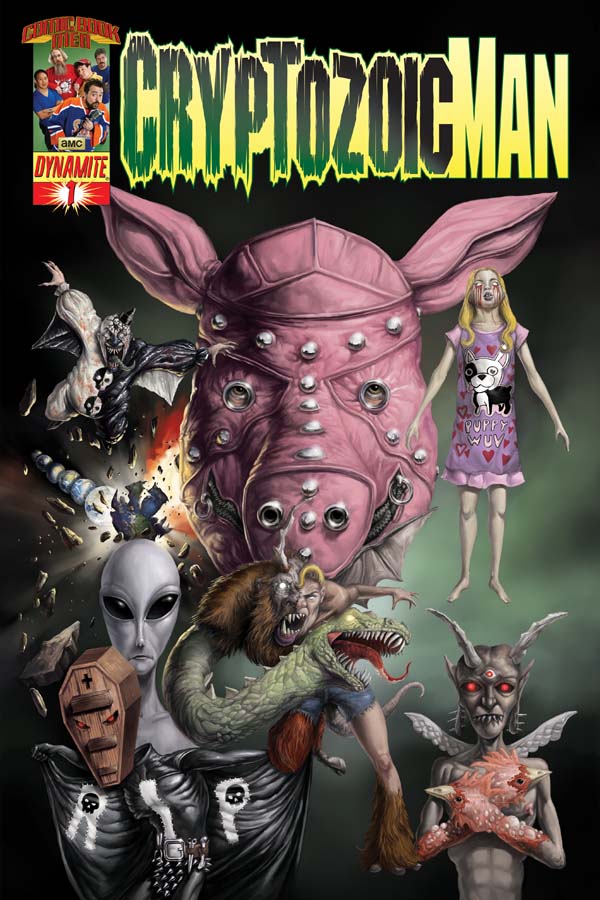
Cryptozoic Man #1 by Bryan Johnson and Walter Flanagan Review


My review of Cryptozoic Man #1 went up today - read the full piece here: http://whatculture.com/comics/cryptozoic-man-1-review.php

Scott Snyder Announces Batman Eternal for 2014


I wrote a news piece on Scott Snyder's forthcoming Batman series, Eternal. Read the full piece here: http://whatculture.com/comics/scott-snyder-announces-new-series-batman-eternal-for-2014.php

Batman: Prey by Doug Moench and Paul Gulacy Review


Set in the early years when Bruce was just starting out as Batman, Gotham City is slowly adjusting to the appearance of the Dark Knight with many still fearing him. Dr Hugo Strange, a prominent psychiatrist, builds upon that fear to leverage power and fame by convincing the Mayor to order Captain Gordon to set up a Batman task force to take down the vigilante and haul him in for questioning. Gordon gets hot-head officer Max Cort to lead the team as another vigilante, a cat burglar, emerges – but what does Hugo Strange really want? 

Doug Moench wrote a lot of Batman comics in the early 90s and none of them were any good. The Knightfall Trilogy where Bane famously broke Batman’s back was wayyy too long and his other books, like the more recent Batman: Unseen with Kelley Jones, have been similarly terrible. Batman: Prey has gained some prominence in recent years thanks to Hugo Strange’s appearance in the brilliant video game Batman: Arkham City, but, based on this book, he’s nowhere near as cool or interesting. In fact, Batman: Prey is a downright awful book but not just because of Strange but because of the entire cast, including Batman, as written by Moench. 

Let’s start with Strange. It’s an obvious comment but the name is apt. When he’s not saying weird things about Batman on TV, he’s talking to his female mannequin in his apartment and dressing up as Batman. Yeah, that’s pretty nutty, but on the barest pieces of information, he’s able to figure out Bruce Wayne is Batman – although never explicitly saying so out loud or to anyone else – and can set up elaborate traps in Wayne Manor involving lifelike mannequins who look exactly like Bruce’s parents. You’d think Bruce would’ve set up some security cameras or anything around Wayne Manor – he is trying to stop people figuring out he’s Batman after all! Anyway, Strange needs to do all of that because the plot says so, not because it makes sense. 

The dialogue in this book is horrendous. Strange spends most of his time turned towards the reader making speeches about this and that, thinking out loud, repeating plot points, etc. Strange’s dialogue is the worst but none of the characters really say anything that sounds at all convincing. Everyone’s thinking out loud and telling you what they’re doing as they’re doing it! 

Catwoman’s outfit is just bad. She’s called a cat burglar in the press so she has to play up the cat part by literally having a tail, cat ears and whiskers, all of which do nothing. If you think the tail is her whip, it’s not – her whip is coiled up around her shoulder. A tail, cat ears, and whiskers – honestly, what’s the point? It’s sooo stupid! Forgetting her appearance (in theory – I won’t forget this, Moench!), she is a completely pointless addition to the book. She shows up, steals some jewels, runs away from Batman across Gotham’s rooftops, escapes – repeat, rinse. They smooch, she saves him (but only because Bruce is so damn incompetent in this book), and that’s it. In other words, just like every other Catwoman appearance ever. 

Max Cort is the worst character in the book. He’s apparently a great police officer who behaves more like a bar brawler, only more dangerous because he has guns. After repeatedly failing to bring Batman in, he’s brainwashed by Strange through hypnosis (really) into becoming a vigilante himself laughably called Night Scourge. He just happens to have a ninja outfit with spikes tailor made for him, complete with a variety of knives and swords, all of which he’s suddenly proficient in, and manages to successfully take on Batman. So, as a police officer with far more resources at his disposal he was unable to do anything about Batman but suddenly, mind-wiped, with fewer resources, and a mask, he’s able to achieve more? Whaaat?! 

But the worst of the bunch is Batman. When Bruce became Batman for the first time, he’d gone through years of training, physically and mentally preparing himself for the demanding role he was now taking on. In Batman: Prey, it’s like that training never took place. Not only can he barely deal with Strange – a non-super-powered psychiatrist – or any of the GCPD, but he’s routinely challenged by no-name street thugs, and, in the second story arc of the book, Terror, he gets beaten up by Jonathan Crane aka Scarecrow! These two are the villains of the book: Strange and Scarecrow, and they’re supposedly Batman’s physical equal! Only in this book. I understand this is Batman in the early years but you can only play up Bruce’s lack of experience so much. 

Moench is famous (relatively speaking) for doing this kind of nonsense narrative. In Batman: Unseen, Batman fights an invisible man by taking off his clothes, drinking the invisibility potion thus becoming invisible – then he puts on his Batman outfit again, negating the invisibility and then goes out to fight him! Moench writes Batman as a brain-dead nitwit and it seems whether he was doing it in the early 90s or the late 00s, that’s how his Batman will always be. 

In Terror, the sequel to Prey, also included here, Scarecrow is the main villain. This story is also utterly hideously written and conceived, but it at least has a genuinely hilarious origin story for Jonathan Crane. Apparently he was teased in high school for being scrawny and his bullies would say to him “Go scare some crows, Crane!” (which sounds exactly like something teenagers would say) and these insults so scarred him(!) that the only way he could relieve his frustration was, yes, scaring some crows(!!!). The panel showing Crane lunging after some crows is amazing. He then developed his own “Crane-style” fighting moves which involves him kicking his legs up really high while waving his arms around - this weird dance move is the same fighting style that bests Batman! So of course he puts on a Scarecrow costume and (sigh) becomes Scarecrow. This is one of the dumbest origin stories I’ve ever read. Good for a chuckle though. 

The story, in both instances, is plodding and tedious at best. Batman is chased by doofuses (doofi?) and, because he’s also moronic in this book, he has trouble escaping them and solving the “mystery”. The storylines are utterly forgettable and stupid, how anyone can rate this book at all is beyond me. Paul Gulacy’s art is no great shakes but I didn’t mind it and it’s definitely the only commendable thing about this book. But it’s still not that good – the expressions on the mannequins and the human characters look exactly the same. 

And one last thing, and it’s rare to have to bring this up, but the lettering in this book is diabolical. Batman’s narrative boxes – of which there are a sizeable number – are written in this flowery cursive style that makes reading them really hard. I suppose this being part of the Legends of the Dark Knight series, Batman is writing these adventures down in a book or something and maybe that’s why we’ve got this awkward handwriting style? It’s the only reason I can see why the letterer has chosen to do this but it underlines a basic truth about comics – if a comic has bad lettering, then it becomes a bad comic. Even if it had legible lettering, it’s still be the pits because of Moench’s script, but the two combined make this a nightmare to read. 

Batman: Prey is a book written by an idiot, for idiots, starring idiots - don’t bother. In fact avoid anything written by Doug Moench!

Batman: Prey

The Private Eye #4 by Brian K Vaughan and Marcos Martin Review


My review of The Private Eye #4 went up today - read the full piece here: http://whatculture.com/comics/5-awesome-comics-you-must-read-this-week-9-october.php/6

Batman #24 by Scott Snyder and Greg Capullo Review


My review of Batman #24 went up today - read the full piece here: http://whatculture.com/comics/5-awesome-comics-you-must-read-this-week-9-october.php/5

Archer and Armstrong #14 by Fred Van Lente and Khari Evans Review


My review of Archer and Armstrong #14 went up today - read the full piece here: http://whatculture.com/comics/5-awesome-comics-you-must-read-this-week-9-october.php/4