My review of Chew #37 went up today - read the full piece here: http://whatculture.com/comics/5-awesome-comics-you-must-read-this-week-9-october.php/3
Thursday, 10 October 2013
Chew #37 by John Layman and Rob Guillory Review
My review of Chew #37 went up today - read the full piece here: http://whatculture.com/comics/5-awesome-comics-you-must-read-this-week-9-october.php/3
Superman Wonder Woman #1 by Charles Soule and Tony Daniel Review
My review of Superman Wonder Woman #1 went up today - read the piece here: http://whatculture.com/comics/5-awesome-comics-you-must-read-this-week-9-october.php/2
Wednesday, 9 October 2013
Marvel Adventures Spider-Man & The Avengers by Paul Tobin et al. Review
I picked up a small stack of these dinky comic paperbacks at a garage sale recently and only just got around to reading the explanation for the title, Marvel Adventures, on the back which turns out to be a line of books for younger readers. That explains a lot! This book is four issues of done-in-one stories featuring some of Marvel’s most famous teamed up with Marvel’s least famous characters having mini-adventures.
Paul “Bandette” Tobin is the writer and, having read his other recent work-for-hire books for Marvel and Dark Horse, he seems to be the go-to guy for writing light-hearted, jokey comics for younger readers and this one is no different. Spider-man, She-Hulk and Tigra go on a shopping spree and encounter The Leader (big green headed dude with a ‘tache) who’s using robotic animals to steal information from SHIELD; Hawkeye and Blonde Phantom stop some bank robbers claiming to have the real Bruce Banner hostage; Hulk and Tigra go to a Hollywood award show only to end up fighting Mysterio; and in the final story, Beast, Spider-Woman, and Giant Girl track down Hercules who’s on a mission to take down a secret Hydra HQ – and woo every attractive woman on the way!
It’s interesting to read some of the lesser-used Marvel characters in a comic, like Tigra and Blonde Phantom (literally a blonde woman in a red dress wearing an eye-mask! Her superpower? Um…), and there are some amusing moments like Mysterio throwing a hissy fit when he loses the Best Special Effects Award or Hercules using jewellery he picked up in bulk at a crafts fair to hit on the ladies. But… they’re very forgettable and disposable stories.
It’s nice to see the characters doing less-dramatic stories – every Marvel comic these days seems to involve the end of the world – and the writing is fine with decent characterisation. The art is nothing special but it’s not terrible either and suits this undemanding book. Maybe these comics are more effective on younger readers but for older readers like me they’re a bit too simplistic and throwaway to fully engage or leave much of an impression.
Marvel Universe Avengers: Spider-Man and the Avengers
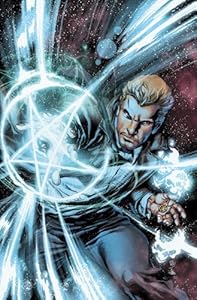
Constantine, Volume 1: The Spark and The Flame by Jeff Lemire, Ray Fawkes and Renato Guedes Review
“Constantine” – right away you can tell DC have fiddled with the former Vertigo fan favourite by naming it after the atrocious Keanu Reeves picture from 2005. It used to be called John Constantine: Hellblazer and the name Hellblazer isn’t mentioned once in this comic. But it’s still recognisably the same character even though the character’s doomed soul isn’t mentioned as much in this reboot than it was before, and I’m not sure it’s once mentioned that he’s from Liverpool, just that he’s English (I’d have LOVED to have heard Keanu’s attempt at a Newcastle accent – if you’ve never heard it, google it and listen to how funny it sounds and then imagine the guy who mangled a British accent in Coppola’s Dracula attempting it. Woah!).
Instead, Constantine is portrayed as a supernatural Indiana Jones, globetrotting ahead of his evil magic rivals to collect the pieces of the powerful talisman known as Croydon’s Compass, a device that alerts its owner to the appearance of any mystical object first. As he travels to Norway, Myanmar and London, he’s chased by Sargon the Sorceress (daughter of Sargon the Sorcerer – imaginative, right?) and Mister E, and encounters other spooky characters like Papa Midnite, Zatanna and the Spectre along the way too.
The book does get a lot right by including a lot of magical action, duels, spells, and everything that should be in a story featuring sorcerers, spirits and wizards, and artist Renato Guedes does an excellent job of drawing these magical scenes really well. Also, Constantine’s devil-may-care, selfish, and roguish personality comes through strongly. Buuut… it’s just not a very interesting story. The first three issues at least have a story arc as Constantine gets the pieces of Croydon’s Compass, but it’s quite formulaic with few surprises along the way – how does Constantine get the pieces? Shows up at a shrine, cracks open a vase, and there it is. And then what happens at the end of the arc? He puts the compass on a shelf and sits in a chair. Oh. How…zzzz…. The remaining 3 issues are a bit of a directionless mess with issue 5 unfortunately being a Trinity War tie-in.
Trinity War was utter garbage but suddenly inserting Shazam into the series is just awkward, not least because it’s a terrible issue or that it has nothing to do with the series or even Trinity War, and is totally irrelevant. It’s just a cynical marketing trick to sell more copies, and fans of New 52 Shazam (there must be some) hoping for something out of the crossover with Constantine are treated to Shazam pushed to the side for the entire issue while Constantine fights a bad guy.
Jeff Lemire co-writes the first four issues with Ray Fawkes and it’s unsurprising that these are the best of the book with the last two containing so little moments of interest that I don’t think I’ll be following the series any further. Constantine, Volume 1: The Spark and The Flame is a decent book in that it’s accessible to new readers and Lemire/Fawkes have more or less captured the essence of the character, but it’s a shame that the series suffers from a lack of a strong narrative to give Constantine a sense of urgency or tension in his adventures. As it is, it feels like each issue of Constantine is the character treading water – not exactly riveting reading.
Constantine Volume 1: The Spark and the Flame
Eternal Warrior #2 by Greg Pak, Trevor Hairsine and Clayton Craine Review
My review of Eternal Warrior #2 went up today - read the full review here: http://whatculture.com/comics/eternal-warrior-2-review.php
Monday, 7 October 2013
Batman, Volume 3: Death of the Family by Scott Snyder and Greg Capullo Review
Wow, Snyder was really swinging for the fences on this one wasn’t he?
(Harp plays, dream sequence graphics)
“Scott, the Joker’s coming back and you’re writing his return!”
“Fantastic! I’m gonna write the hell out of this!”
“Right, so it’s gotta be big, got that? He’s a Big Deal, he’s our best villain, he’s partly why Batman’s so damn popular, and the fans adore him even though he’s a stone cold psycho”
“OK, OK, so we’re talking epic, big entrance, big story, big scenes”
“The whole shebang, Scott, throw the whole damn kitchen sink into this one”
(Scribbling furiously in his notebook) “I think I’ve got it. How about a Joker story…”
“Yeah…”
“... that features EVERY great Joker story. The title will even reference the book where he killed Robin”
“I love it! Get going, you and Greg are gonna make a classic, I can feel it!”
“Will do, Chief! (Scott puts on his best Columbo impression) Just one last thing though: why did Joker remove his face in the first place?”
“...”
(Dream sequence fades out as the DC Editors stare dead eyed as Snyder backs away to the door)
In the first issue of New 52 Detective Comics Joker breaks out of Arkham and has his face removed by Dollmaker who hangs it in Joker’s cell. That was the last we saw of Joker for over a year. In Death of the Family, Joker returns with a pretty big bombshell - he knows the secret identities of everyone in the Bat family. Not only that but he resents the Bat family and preferred the days when Batman was a solo act, so he’s going to kill them all so it can be like the old days, just him and Bats, together at last. Lock the gates on the kingdom of madness and let the massacre of the innocents begin!
Scott Snyder by now has shown just how deeply he understands Batman. This guy has done absolute wonders with the character since he got put on writing the backups of Detective Comics and then got bumped up to the main title. His New 52 stuff with Greg Capullo is damn near flawless, introducing a whole new gang of villains, the Court of Owls, and if, like me, you’re reading the current monthlies, you’ll be eating up the Zero Year storyline like Deadpool gobbles up chimichangas. This dude can write, he has some big stories to tell and he is chocabloc with original new ideas on old characters.
This is decidedly a Joker book - and if my proselytizing thus far hasn’t hipped you otherwise, I think Death of the Family is one of the best Joker books ever written - and Snyder comes to the table with all kinds of strange, brilliant ideas about the Joker. He frames Batman and Joker’s relationship, through Joker’s eyes, as a sick bromance, the Joker believing he is doing all that he does out of a shared closeness with Batman, and Death of the Family comes off at times like a hideous love story, or like a Dark King and his most trusted advisor, the Fool.
If you’ve ever wondered why Batman doesn’t simply kill Joker, because he’s irredeemable and will surely continue killing ad infinitum, Snyder answers this both from Batman and Joker’s perspectives, with both arriving at the same startling conclusion (in separate scenes). There’s also a simply amazing scene at the end that answers the other question you might have with this book which is why Joker doesn’t attempt to find out who Batman is, rather than just the Bat family, that is something I don’t think I’ve seen in a Joker story before and adds another degree of insanity to Joker’s psyche. And bravo to Greg Capullo for the whole book really but that one panel where Joker looks to the side in that scene and we glimpse the look in his eyes? Wow. Utterly chilling, and does complete justice to Snyder’s idea.
Thematically, this is a story of identity, not just the identities of the Bat family which are at stake, but also Joker’s identity, Batman’s identity, and Gotham’s identity. Despite my snide (yuk yuk) imaginary conversation at the start of the review, I can hazard an interpretation for why Joker’s face was removed, namely as a heavy handed metaphor for change and Joker’s new look in the New 52 (a reboot itself). That factors into the Joker of this book who, in his time away, has undergone radical changes to his personality to the point where even his devoted sycophant groupie, Harley Quinn, is terrified of what Joker’s become. Joker has changed and become even more monstrous and cunning in his time away.
We learn just how intricate his plans have been as the story goes on, but first: his entrance. It’s pretty damn amazing. In overalls, he shows up at GCPD headquarters in the doorway, his head cloaked in shadow, his figure recognisable just long enough for Gordon to see him - and then the lights go out. Chaos ensues as necks start breaking and laughter echoes in the darkness before the lights turn back on, Batman arrives, and he and Gordon are surrounded by dead policemen with Joker’s face missing.
From there, Snyder takes us on a whirlwind tour of Batman and Joker’s greatest hits - the ACE Chemicals Factory from Killing Joke (and the 1989 Batman movie), to Gotham Reservoir from The Man Who Laughs, to Arkham Asylum and culminating in the caves beneath Wayne Manor. Each scene is amazing for different reasons as he utilises his classic Joker toxin, to henchmen with rocket launchers, to some straight up Hannibal Lector insanity in Arkham, and a kind of Sophie’s Choice ending. These are the features of Batman and Joker’s relationship.
One last note about identity and, though it concerns the ending it’s not a spoiler, but Batman defeats Joker with the threat of identity and a bluff trumps a bluff. I won’t say anymore, I just wanted to acknowledge the genius of the ending.
Which brings me to some critiques of the book. Now don’t get me wrong, I loved this book, I’ve read it several times now and it’s amazing every time, and though there are some things about the book I didn’t like per se, they’re not nearly problematic enough to make me dislike it. It’s like Nolan’s The Dark Knight; it has some issues but the whole is so damn impressive that you can’t help but love it.
Joker’s face - now, even if you take the origin of Joker as that in The Killing Joke where an ordinary man falls into a vat of acid and has his hair turned green and his skin turned white, it’s still human skin. Acidically changed, yes, but still human skin. It’s been lifted off of his face for over a year - and yet still its malleable enough to retain the shape of Joker’s face and hasn’t dried out!? How Joker’s survived so long without skin covering his face is bizarre enough, but I guess that’s the character. But when he gets it back, he puts a strap on it and wears it like a party mask! He doesn’t even try getting Dollmaker to stitch it back on, which presumably Dollmaker could do given his skill shown in this book, instead opting for a weird mask look. Anyway, that’s the last I’m going to mention Joker’s face, it just annoys me is all.
Joker is far too powerful in this book - Joker manages to do everything right in this book to an uncanny degree. He’s going up against Batman, a man who once prepared for his own mind to be wiped by creating a backup Batman identity in his own brain (granted this was pre-New 52, but still) - Batman is no idiot, he is insanely prepared for every eventuality, but can’t seem to catch Joker and stay with him, or ahead of him, in this book. In every scene I mentioned earlier, Batman’s at a disadvantage, even right at the end at the dinner scene - Joker is incredibly prepared to an insane degree that it’s too uncanny, he’s too good.
I do know why Snyder chose to do this, because his ideas about the character and his relationship with Batman won’t play out and won’t work unless Joker is superhumanly prepared in every instance, and has managed to concoct ridiculously elaborate setups. I wouldn’t have it any other way, but in no other book, ever, is Joker quite so infallible than he is in Death of the Family, and that bugged me a bit.
The unpleasantness of it all - Snyder’s background is horror. He created American Vampire, his big break in comics, he wrote an amazing and underrated book with Scott Tuft called Severed about a serial killing cannibal who targets kids, and he’s currently writing The Wake, an underwater horror story starring murderous mermaids. His entire work with Batman could also be called horror and it’s arguably why he’s been so successful with the character - Batman is a figure rooted in horror, whose entire appearance is aimed toward instilling fear.
But did we need to see that scene in Arkham? The tapestry scene. It’s very unpleasant and involves Dollmaker. Does Joker’s face need to be peeling off and held on by straps so we get peeks at his raw flesh beneath? Or that church scene? Over-the-top gruesomeness isn’t something that’s going to bother everyone but I feel Snyder, in his effort to go really, really big on his Joker story, went a bit overboard with the gore and unpleasantness that surrounds the character. Parents thinking of buying this for your kids: warning, this is definitely not a kids’ book. I’d say the audience would be 15 and over at least. Also, there’s this weird panel where Joker yells at Batman to “sit his ass down” and “ass” is censored - so they can show that tapestry scene in a comic but not the word “ass”? What a strange rule!
Those are my complaints and really they’re negligible at best when considering the scope of this story. The title of the book is both in keeping with Snyder’s referencing of Batman/Joker stories but is also about the story itself and the resolution. There’s even a reference to Joker’s first victim from way back in 1940 - it’s such a layered, incredibly detailed book, from soup to nuts, that you can’t help but give it to Snyder. He really went for it in this one and he really pulled it off.
So before we close up, let’s talk about Greg Capullo. Who honestly would’ve thought a Spawn artist would be the perfect guy to draw Batman? Snyder apparently, and it was an inspired choice because Capullo is the man. The way he frames the scenes is perfect, from the GCPD HQ scene, to the Gotham Reservoir scene to the finale that riffs on the detective angle and feels like Holmes/Moriarty’s last bow over the Reichenbach Falls - he knows how to frame a scene, he knows how best to present it, and he can draw like a god. Individual pages that stuck out for me was the one where Batman is sat atop a horse (that he just punched!) looking like a chess piece that was so beautiful, and the faux-Sword in the Stone scene in Arkham was mesmerising.
Batman: Death of the Family is a fantastic Joker story and easily ranks among the character’s best books, not to mention that it’s yet another triumphant feather in the cap for the finest creative team at DC right now, Snyder/Capullo, whose run on this series will surely go down as one of the greatest runs on any comic book character ever.
The book ends the only way it can with Batman defeating Joker – but, brilliantly, Joker still has the last laugh. Look at Batman’s expression on the last page as he realises that after everything, Joker actually won right at the end.
Ha.
Ha.
Batman Volume 3: Death of the Family
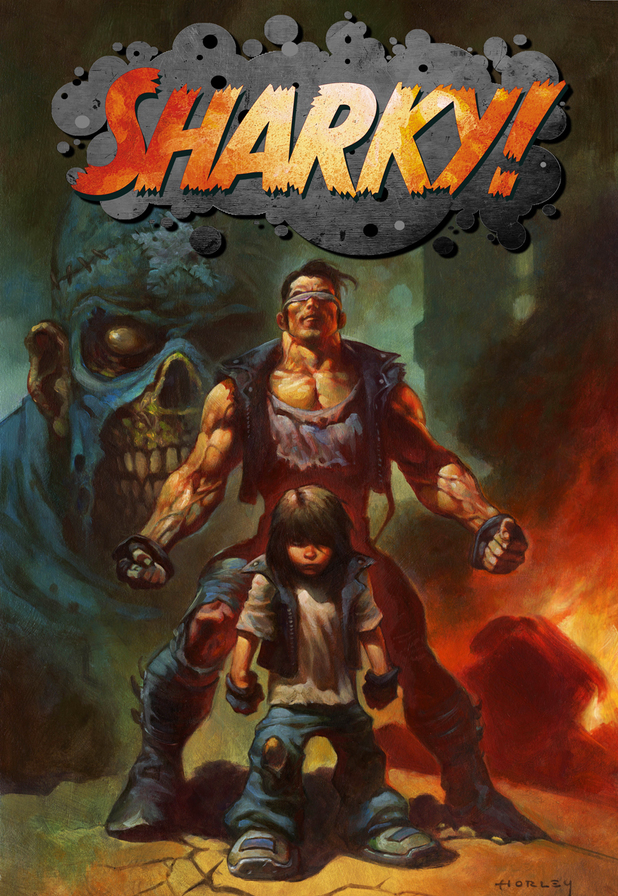
Sharky! Volume 1: When Titans Clash! by Dave Elliott and Alex Horley Review
My review of Sharky! Volume 1 went up today - read the full review here: http://whatculture.com/comics/sharky-volume-1-when-titans-clash-review.php
Sunday, 6 October 2013
Shadowman #11 by Jim Zub and Miguel Sepulveda Review
My review of Shadowman #11 went up today - read the full piece here: http://whatculture.com/comics/shadowman-11-review.php
Saturday, 5 October 2013
The (True!) History Of Art by Sylvain Coissard and Alexis Lemoine Review
The (True!) History of Art is a book that uses the traditional three panel structure of a newspaper gag comic and incorporates some of the most famous paintings in the world to explain why they look the way they do. For example, Edvard Munch's The Scream is distraught because he lost his wig and people are going to see him bald! Or the reason why Van Gogh's Bedroom in Arles is so tidy is that he cleaned up after receiving a text from his mum who's coming home unexpectedly early.
It's a simple idea but Sylvain Coissard and Alexis Lemoine do a great job of pulling it off effectively, and made me laugh several times over the course of reading it. It's by no means a long book coming in at just under 50 pages, and it's subject matter makes it more of a novelty book, but it's well produced in a nicely bound, little hardcover with high grade paper used so you're getting a quality book despite its brevity.
The strips are done with the final panel always being the actual, unaltered artwork and the preceding two panels either being an original piece of illustration or a photo-shopped image of the original to set up the punchline, kind of like Terry Gilliam's work in Monty Python. It's very skilfully done by artist Alexis Lemoine, especially as the jokes rely so much on the art stylings being consistent with the actual art to work.
Even if you don't know much about art history – and I'm one such reader – a lot of the pieces used are so famous, like The Scream or the Mona Lisa, that everyone can recognise and enjoy the subversive strips. But you don't really need to know the art to enjoy the book, each short strip is self-explanatory, and you're bound to come across an interesting piece of art you never saw before and might want to learn more about.
There's a repeated strip by a 16th century artist I'd never heard of called Giuseppe Arcimboldo, whose work incorporates surreal elements into traditional portraits. So in pieces like Spring there's an ordinary woman in profile in the first panel, being hit by a massive bunch of flowers in the second, and in the final panel looks like the finished piece of a woman covered in flowers; or in Fire, an ordinary man with a cigarette is hit by a burst of fire and looks like Arcimboldo's piece of a man whose scalp is on fire. It's a silly, throwaway gag that's surprisingly funny as the book goes on, but Arcimboldo's art is so interesting it also made me want to find out more about him.
The (True!) History of Art is a short but well put together book, both physically, artistically and conceptually, and definitely worth a look for the imaginative and funny ways Coissard and Lemoine render famous art to tell new, funny stories. If you enjoy art and have a good sense of humour, pick up The (True!) History of Art for a fun little read.
The (True!) History of Art
Forever Evil #2 by Geoff Johns and David Finch Review
My review of Forever Evil #2 went up today - read the full review here: http://whatculture.com/comics/forever-evil-2-review.php
Thursday, 3 October 2013
Superior Spider-Man, Volume 3: No Escape by Dan Slott and Humberto Ramos Review
The third volume in the utterly brilliant Superior Spider-man is yet another winner from Dan Slott and his cadre of super-talented artist collaborators. Comprising two 3-issue arcs, both storylines are amazing in different ways but share an originality and freshness that permeates this series.
In the first story arc, Spider Slayer is to be the last prisoner in The Raft, the island prison off of Manhattan, to be executed by the state. His crime: murdering J. Jonah Jameson’s wife. Jameson asks Spider-Man to join him on the day of execution to ensure the death penalty is carried out and, of course, things don’t go the way he planned. As well as Spider Slayer, fellow prisoners Boomerang, the Vulture, and Scorpion also run riot, enhanced by Slayer’s mini-robots.
There are so many details about this story that I loved, but, importantly, I really enjoyed the story itself. Spider-Man anticipating Slayer’s escape and his spider-bots going toe-to-toe against Slayer’s spider-bots was really fun, and seeing Jameson get in on the action himself was great – and he holds his own too! I won’t say how it plays out but it is handled superbly with Slayer thinking he has the upper hand because he knows what Spider-Man would do - except this is Otto the Superior Spider-Man and he’s constantly surprised by new Spidey’s choices, as are we as readers.
The Raft was meant to close but because of something Jameson says to Spider-Man during the escape attempt, Spider-Man’s able to take The Raft as his own private lair. It’s brilliant how Otto has adapted to the role of superhero but still has the mentality of a supervillain, getting a lair, building his robots, even acquiring henchmen (called “Spiderlings”!). It’s both really funny and says a lot about the character, distinguishing Otto once more from Peter’s Spider-Man.
The second story arc deals with Kingpin’s Shadowland headquarters, a crime nexus in the heart of New York. Shadowland was a series Marvel did a few years ago which I admit I didn’t read but, having read some reviews of the series, don’t feel I missed much. This much I know: it looks like an Eastern fortress and it’s making the residents living around it miserable. Why the Avengers don’t stomp it to pieces, I don’t know, but Spider-Man decides to do just that and, armed with his giant robot spider and army of Spiderlings, smashes Shadowland, putting Kingpin on the run – incredibly all in one issue!
This is why I like Superior Spider-Man than just regular Peter Parker Spider-Man – Peter would never do anything like this, despite knowing Shadowland exists. He just doesn’t have the wherewithal to do something of this scale, the planning, the imagination, the firepower, the balls - but Otto does and pulls it off admirably. Otto is proactive compared to Peter who was only ever reactive. Otto’s also got no boundaries, is unafraid of taking huge risks, and his boundless ambition and confidence creates enormously exciting stories within a short amount of space, all to the good. He’s redefining Spider-Man as a superhero and crime-fighter.
The other issues in the story arc feature Phil Urich, aka Hobgoblin, whose tenure as Kingpin’s henchman is up once Spider-Man appears to tear down Shadowland, so has to find other financial sources. Luckily for him the Goblin King has hacked Spider-Man’s spider-bots so that anyone resembling a goblin is undetected, allowing Phil to get away with his crimes much to Spider-Man’s frustration. Without going too deeply into the plot, there is one moment that stands out as remarkable and that’s Spider-Man’s outing of Phil Urich as Hobgoblin on every screen in New York! He does this primarily to get the people of the city to help him prevent further crime sprees but it’s doubly surprising in that he chose to reveal Phil as Hobgoblin so publicly – again, Otto is one unpredictable superhero and one determined to use all of the resources he has at his disposal.
It feels like all of this is enough for one book, right? Well, I haven’t even mentioned the other storylines Slott is juggling like Otto getting his PhD from former classmate Professor Lamaze, whom he despises, or his burgeoning relationship with Anna Maria, or how Carlie Cooper is closing in on discovering “Peter’s” secret identity. And I still haven’t mentioned the other big moments in this book like a character death and the emergence of a powerful new enemy! It’s insane how much Slott is putting into this story, it is absolutely bursting with creativity in one of the most engaging stories I’ve ever read from Marvel, let alone starring Spider-Man. Slott is a genius and Superior Spider-Man, I have to say once more, is a masterfully written book by one of the greatest talents Marvel has. Slott’s bringing his A-game to every issue and it really shows.
I think I could write a dissertation on Superior Spider-Man if I wanted, it’s so richly textured and layered – but I’ll leave it with this review and simply say I loved this third book like I loved the last two and can’t wait to read the next one. I don’t know who can read this and think otherwise, but there is only one verdict for Superior Spider-Man: it rules. Treat yourself to this incredible story and read it today!
Superior Spider-Man - Volume 3: No Escape
Wednesday, 2 October 2013
X-O Manowar, Volume 3: Planet Death by Robert Venditti, Cary Nord and Trevor Hairsine Review
After repelling the Vine’s invasion of Earth, Aric, together with Shanhara the sentient X-O Manowar armour, takes the fight to the Vine homeworld in an attempt to end the threat to Earth and free his people, as well as every other race captured by the Vine, from enslavement. What happens next? The title says it all: Planet Death.
That said, even if there is a lot of fighting in this book, it’s a surprisingly deeper read than you’d expect. I mentioned in a review of an earlier volume that writer Robert Venditti has portrayed the Vine – the spider-faced aliens who abducted Aric – as more than just the villains of the piece, and he continues to write them as more complex and interesting characters than simply one-dimensional bad guys fulfilling a role.
A lot of the book goes into exploring the Vine culture and divided peoples, some of whom favour war, others who prefer a more peaceful solution, and both groups of people will suffer Aric’s wrath. It’s a gifted writer who can have you sympathizing with a supposedly villainous race and actually feeling pangs of sadness at seeing them die, and Venditti is nothing if not gifted.
Aric’s character continues to be explored too as he’s confronted with an old friend whom we met in the first volume and has reappeared here in altered form. Aric’s response is impressively noble and broadens his character from that of his seemingly thoughtless fighter, ask-questions-later persona. Cary Nord and Trevor Hairsine contribute amazing art to the book with Hairsine bringing his robust style to the Planet Death prologue and Nord showing us why he’s an award-winning illustrator with his action set pieces.
This is a book that doesn’t need to be as smart as it is, and yet it is. The cover, the title, the main character, all put you in mind of a brainless slug-fest and, yes there are some fantastic fight sequences, but the characters are well written and at Volume 3 in the series are definitely well rounded and realistic - even the aliens!
The story is completely engaging and is a fascinating one that straddles the line between fantasy, sci-fi and superheroes, taking elements from all genres and creating something original. X-O Manowar is just a remarkable series that’s well worth your time - Volume 3 is another success in the series and, having switched to the monthlies now, I can only say the series continues to be of a high quality. Well done, Valiant and co!
X-O Manowar Volume 3: Planet Death
Captain America: Living Legend #1, The Trial of the Punisher #1, Mara #6, Quantum and Woody #4, All-New X-Men #17, Batman Black and White #2 Reviews
I review the 6 best comics of the week - read the full article here: http://whatculture.com/comics/6-awesome-comics-you-must-read-this-week-2-october.php
Tuesday, 1 October 2013
Journey Into Mystery Featuring Sif, Volume 1: Stronger Than Monsters by Kathryn Immonen Review
Here’s the deal: I’ve written too many 1 star reviews which were detailed breakdowns about the problems of superhero comics from Marvel and DC and, besides some books that deserve more scrutiny, they pretty much say the same thing every time: a lack of imagination, a lack of strong character development, generic storytelling, blah blah blah. Journey Into Mystery is guilty of the same sins but isn’t worth writing about in detail. Instead I’m going to propose ways that this comic could have been improved. But before we start, I’m aware that Journey Into Mystery is now cancelled so these changes come too late, and, having read Stronger Than Monsters, I can see why Marvel made that choice. These are just ideas that could’ve saved the series and that interest me as a superhero comics reader looking for something a little different.
This book is about Lady Sif who is basically written as female Thor. This is terrible because it’s essentially saying she has no character and is different from Thor purely because she doesn’t possess a Y chromosome. So let’s distinguish Sif in some way from Thor - like maybe NOT a warrior obsessed woman out to prove a woman is as deadly as a man. Yawn. Been done. I don’t think anyone doubts women can kick ass like men, so how about women - Kathryn Immonen I’m looking at you - drop this as an issue forever? How about we take it as read that Sif can look after herself and make her stories NOT warrior/fighting themed or about honour and other overused concepts like that but about these things instead:
1) Explore current popular culture. Sif could be walking through a city that is holding a Justin Bieber concert. Interested, she follows the crowds of fans and winds up inside the concert, hears Bieber’s music and decapitates him. And maybe Sif goes after a few other annoying celebrities while she’s at it - Mel Gibson, One Direction, Michael Bay movies, and so on. Sure, it’ll date the comic but at least make it more memorable than it was, and it’ll have grabbed some headlines and shifted more copies of the comic than it previously did.
2) Make her guileless and child-like in outlook, but still of course deadly. Instead of a jaded, weary attitude, how about cheerful and happy - Marvel, you’re not DC, you can do this. Your characters don’t all need to be tortured, brooding dickheads gritting their teeth like they’re constipated while standing in the rain - they can celebrate the good things in life. Sif can help out ordinary people with their lives as she wanders through Midgard, kicking bullies’ asses, and brightening up lives wherever she goes. Being angry, crazed and bloodthirsty like she is in this book is boring. Going after bankers or Richard Branson and humiliating them? I’d like to see that. Remember that Captain America cover of him punching Hitler? Let’s get back to that for the 21st century!
3) Break the fourth wall. Deadpool can do it, why not Sif? It makes her a more urgent presence on the page and makes her more personable. And while we’re at it, let’s cut the “thou” and “wilt” and all that crap. It was never good back in the 60s when it was introduced and, decades later, it’s still not good. Give her a sense of humour - women superheroes are important to have but female supes who don’t take themselves too seriously are too few and far between. Women can be funny too, why not Sif?
4) The title is Journey Into Mystery and riffs on the campy sci fi/fantasy stories of yesteryear - so let’s go for it. Don’t half ass it guys, you want to write stories from way back when with aliens from Mars and crazy adventures into unknown realms, really go for it. Make a story that’d make Grant Morrison shake his head in frustration, muttering “they went too far!” in every issue. Why not play around with form like Jeff Lemire is doing with his Vertigo series Trillium? Journey Into Mystery is one of the lowest selling books, so no one gives a crap what you do with it, so take some chances. Print it in four colours. Print it in black and white. Print it all in one colour. Print it back to front. Print it in single sheets, jumble them up, sell the pages loose in bags and have the reader construct their own journeys into mystery. Print it as a graphic poem. Print is as a song that only people who can read music can understand. Print it in prose.
5) Have Sif join the Scandinavian band Lordi and enter the Eurovision Song Contest.
6) Make Sif gay in defiance of DC’s latest bullshit and stage an enormous gay wedding with everyone in the Marvel Universe.
7) Have Sif fight a wizard, a band of dwarves, and an annoying midget with giant hairy feet who’re victimising an innocent dragon.
8) Have Sif parody famous Marvel stories, or even parody current Marvel Events like Infinity or Battle of the Atom - with sock puppets.
9) If you still want to do a Sif as female Thor story, go HUGE with it. Thor fights a God Butcher? Sif fights a Universe Killer. Or a dozen Universe Killers, one for each Universe they’ve killed. And the stakes are - the death of the reader of the comic itself!
10) Make Sif interested in a popular sport like golf, tennis, football (either American or soccer), basketball, baseball or racing - there aren’t enough sport comics out there and, as Brian Wood shows with his Image series Mara, there really need to be more. Sif the Olympic Gold Medallist - why not?
11) Sif gets sucked into World of Warcraft - the actual game - and has to fight her way out.
12) Sif parodies DC Comics stories, old and new.
13) Sif reviews pop culture - a review of GTA 5 or Matt Damon’s latest movie? I’d read that!
If I thought about this more I’d definitely come up with a longer list but I think I’ll stop there - you get my point. What you get with the actual book is a generic superhero fighting comic featuring a humourless and bland main character and a totally forgettable story. I would rather have read a comic featuring any or all of the ideas above. How about it, Marvel? You are the House of Ideas, after all! Prove it.
Journey Into Mystery Featuring Sif - Volume 1: Stronger Than Monsters
Subscribe to:
Posts (Atom)