Pages

Tuesday, 8 January 2013

Best Books of 2012 Part 3


I was given a Kindle for my birthday in 2012 and as a result I keep an eye out for books that are super cheap that Amazon occasionally decrease significantly, seemingly at random, so they end up costing around 20p. “An Idiot Abroad” is one such book but I have read Karl’s other books  in the past and enjoyed them enormously.

Karl Pilkington is a Mancunian former radio producer who worked on Ricky Gervais and Stephen Merchant’s XFM radio show in 2001/02 and Ricky got so taken with him and his appearance, coupled with his somewhat uneducated, somewhat simplistic, almost childlike worldview, that he became part of his close circle of friends. Since the radio show ended, Karl has become the focus of a series of podcasts which have been incredibly successful, and launched his career in front of the camera with cameos in Ricky’s projects and a TV show for Sky, “An Idiot Abroad”.

The comedy stems from the fact that Karl doesn’t enjoy leaving his comfort zone, that is, his flat in London. Sending him into the big wide world and some truly astonishing locations, far from the food and routines he’s used to, make for some pretty enjoyable television, and the accompanying book is also very funny too. It’s easy to read, includes some excellent jokes, and readers will fall for this grouchy everyman as he grumbles his way across the globe.


“It's been a few years since I checked in with Karl. I used to love the Ricky Gervais show on XFM and even the podcasts/audiobooks that followed have been good (but not as good as the radio shows) and I loved the subsequent books "Happyslapped by a jellyfish" and "Karlology" and would recommend anyone who enjoyed "An Idiot Abroad" to check those out. So it was interesting to check back in with Karl after a break of years to see what he's been up to. Thankfully, he hasn't changed. At all.

The moaning Manc is still talking about his various body parts as if they're individual to him: "me legs get tired before the rest of me body does" and "me brain was stressing me out - it knows I don't like it so why does it do that?". And of course he's still being picked on by Ricky Gervais and Stephen Merchant, this time from afar, as they send him into the world to see the Seven Wonders and throw obstacles in his path. When he goes to Israel he's kidnapped and held captive except Karl doesn't know it's not for real, it's training. When he goes to China he's made to fight trained Shaolin experts and when he visits Mexico he's put in the ring with other Lucha Libre wrestlers. And of course wherever he goes he's challenged to eat the local delicacies involving animal parts like eyes, brains, as well as various bugs.

Karl handles it as best he can but as a reader you're always rooting for him, he's just too likeable. His no-nonsense approach to life coupled with his strange outlook and way of seeing the world are what has made him so famous, and if you're a fan (a KP nut) of his previous books and recordings, you'll enjoy seeing Karl deal with these odd situations and places in his own unique way. "An Idiot Abroad" is a great read and had me laughing throughout, the only thing missing was Monkey News. Karl really is a national treasure and should be titled the Eighth Wonder of the World.”

An Idiot Abroad: The Travel Diaries of Karl Pilkington

*

Nick Hornby wrote a column in “The Believer” magazine from McSweeney’s called “Stuff I’ve Been Reading” which was a monthly column that talked solely about books he’d been reading. He also included, at the start, two columns: “Books I’ve Read” and “Books I’ve Bought”, ingeniously showing what every bibliophile already knew, that they bought far more than they read. Hornby’s first book of collected columns was fantastically entertaining, especially as reading reviews (and writing them!) is something I enjoy and reading reviews by famous writers? That’s the jackpot, for me anyway. Also I discovered a number of excellent books from his recommendations. Which is why the second book, “Shakespeare Wrote For Money”, disappointed me so much as it felt like Hornby had tired of the format and begun to lose interest in writing the column. His picks were dull, his reviews unfunny, and it was no surprise when he packed up the column.

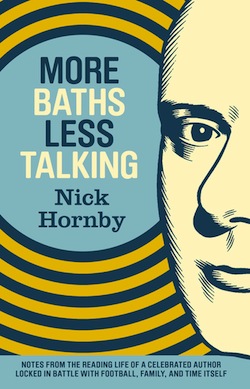
For a year and a half anyway, and it turns out the break did him good because “More Baths, Less Talking” came out this year and it was gravy. Full of the kind of energy and wit that has made Hornby such a popular writer, this collection reminded me why I’d enjoyed this column so much the first time around. For people who enjoy reading about people reading – yes I know it’s weird – this is a must-read.


“I was surprised to hear Nick Hornby had another book of "Stuff I've Been Reading" columns as he said the previous one, "Shakespeare Wrote for Money", would be the last of them (not a bad decision as I felt it was tired and unenthusiastic). More surprising was that when I decided to buy it, I really enjoyed reading it. It's like running into an old friend after a few years apart and it turns out you both have a lot to talk about - or in this case, one person has a lot to say and the other wants to read it.

After a nearly 1 and a half year break, the book picks up the first column in May 2010 to the last in December 2011. Hornby's humour is as sharp and effervescent as ever but more importantly his enthusiasm for reading and the books he's read is infectious. I think what made me like the book more was that this time around he picked books that weren't necessarily well known in the mainstream and consequently I wound up picking up some excellent titles from the columns, one of which I'm two thirds of the way through and enjoying the heck out of - "The Driver's Seat" by Muriel Spark.

Recommendations like "Book of Days" by Emily Fox Gordon, "Whoops!" by John Lanchester, and "Charles Dickens" by Claire Tomalin, are all books I wouldn't have heard of without him (maybe not the Tomalin) nor would I have felt the urgent need to read them. It's also enjoyable to read Hornby's reviews of books I've already read. Books like "The Anthologist" by Nicholson Baker, "The Psychopath Test" by Jon Ronson, and "Huckleberry Finn" are all reviewed well (except "Finn" which is just one word - "meh". The Believer, which publishes these columns, doesn't believe in negative reviews so Hornby has to keep the pages bile-free).

One of my favourite things to do after reading a book I liked/disliked is to go online and read what others felt about it. Sometimes it's cathartic if I hated it and sometimes I learn something about it I missed when reading it; but reading others' reviews is always enjoyable and when it's someone famous for their writing doing it, so much the better.

Hornby's ingenious format of putting two lists at the start of the column "Books I've Bought" and "Books I've Read" is still fascinating to look at from the perspective of someone who loves books as much as Hornby and buys far more than he reads.

Well, I'm glad he's back doing it. This is a fantastic read which I flew through in two sittings writing down titles to pick up and laughing at Hornby's assessments of some books as well as digs at his publishers, and I really had a great time with this book. For bibliophiles everywhere, this is a must-have.”

More Baths Less Talking: Notes from the Reading Life of a Celebrated Author Locked in Battle with Football, Family, and Time Itself

*

Christopher Hitchens’ final book is a collection of brief essays he wrote while dying from throat cancer. “Mortality” contains some excellent essays and some lesser ones, but it’s remarkable that he was able to write at all when taking into account his condition. His strength to keep going every day, doing as much as he was able that he had done in all the years past, is nothing short of admirable and his integrity in remaining his own person, meeting death with dignity, shows the enormous will of the man. It is a brief but sobering book but well worth your time.


“Most of us have had contact with cancer in our lives - we've either experienced it firsthand or know (or known) a family member or friend who has had it - and in each instance it's been horrible, an experience unlikely to provide you with much and likely to take a lot from you, if not everything. But most of us aren't Christopher Hitchens - if fact none of us are, and that's why we know who was. He was a unique voice whose essays, columns, articles, and books made the person reading them much more enriched having read them.

"Mortality" is his last book (though I'm sure further anthologies of unpublished material will appear in the years ahead) detailing his fatal encounter with esophageal cancer, from discovering it while on a book tour promoting his memoir "Hitch 22", to the final pages which are scraps of notes for future (and now forever unwritten) writings.

But it's not a sad book. Hitchens was ruthless in his approach to subjects and he is no less so when dealing with himself and "the alien" (which is how he characterises his cancer) - no sentimentality or feeling sorry for himself is allowed on the page.

He is informative, funny, and stubborn all at once when writing on the reaction among religious groups when news of his cancer was reported with some Christians instigating a "Pray for Hitch" day - a day he encourages everyone to ignore. He also reinforces his atheist position, almost aggressively, writing "What if I pulled through and the pious faction contentedly claimed that their prayers had been answered? That would somehow be irritating." As if he wanted to die to once more further his argument that there is no God! If this book shows anything it is that death and the prospect of death does not change the person, and that Hitchens remained dignified and his own person right to the end.

There are essays on coping with the cancer treatment which is almost as bad as the cancer, and a fantastic piece on Nietzsche and the etymology of the phrase "whatever doesn't kill me makes me stronger". The book is full of rich writing displaying a luminous and inquisitive mind, questioning death, the mundanity of illness, and moving from issues of existence to anecdotes of past columns such as the time he underwent waterboarding to experience how bad a torture it is (very bad as it turns out, traumatising in fact).

Also included is a foreword by Hitchen's editor at Vanity Fair Graydon Carter and a moving afterword by his wife Carol Blue. Our culture lost a brilliant mind on December 15, 2011, and "Mortality" is a fine coda to a man who lived life fearlessly and wrote some of the best reportage of the last 50 years. Christopher Hitchens remains an essential writer to read.”

Mortality

*

This book came out last year but I only got around to reading it this year. Grant Morrison, comics writer extraordinaire, writes down all he knows about superhero comics, their history, and throws in a kind of potted autobiography as well. Morrison is an amazing writer with a 30 year career in the field and an enviable list of titles under his belt, notably “All Star Superman”, “WE3”, and his current work on Batman. His writing in this book is lively, chatty, enjoyable, and informative. For a comics fan like myself, it is an excellent book to read when you want something more substantial than graphic novels to sink your reading teeth (?!) into.


 “One of the most interesting and best comics writers, Grant Morrison, has produced a chronicle of comics from their inception in the late 30s to the present day, along the way talking about superheroes and their effect on our culture as well as providing a look into his own turbulent life from quiet teen to superstar writer. "Supergods" is throughout a fascinating look at this wondrous creation, the superhero.

For me, a huge fan of comics and superhero comics, the book was great fun to look at the inauspicious beginnings of the genre, the creators Joe Shuster and Jerry Siegel and Bob Kane and the oft forgotten Bill Finger, through its various incarnations through the years. Morrison goes through the book chronologically and devotes the first chapter to an extensive look at the front covers of "Action Comics #1" and "Detective Comics #27", the first appearances of Superman and Batman respectively, setting the tone of the book as an in-depth look at Morrison's two favourite characters in comics.

He divides the evolution of comics into different "ages" from the Golden Age, Silver Age, Dark Age, and Renaissance Age (which we're currently in), and I won't go into detail as to every age but suffice it to say for those who believe Morrison wasn't detailed enough, I found him more than adequately explaining the relevant heroes and writers of the time in the context of the era and its effect down the line on future writers, innovators and characters.

Morrison could quite easily have written a memoir of his own life in this book but chooses to occasionally throw in tidbits of his autobiography amidst the intricate pontificating upon superheroes. We find out about his modest childhood and his journey into comics through endless writing and drawing and sheer persistence before landing a job with 2000AD and from there to DC's "Animal Man". There are some gossipy bits thrown in like an anecdote of Glenn Fabry biting Karen Berger's ass during a party welcoming the British Invasion of writers and artists to America, as well as a glimpse into why Morrison's relationship with Marvel soured following the dissolution of "New X-Men" (it also might explain why Marvel didn't allow Morrison to use any of the covers of their comics for reproduction in this book, unlike DC who did) though Morrison's breakup with protégé Mark Millar is ignored (unlike in the documentary about Morrison "Talking with Gods" where he says if he was in a car and saw Millar on the street, he'd change course and accelerate).

Then there's the vast wealth of information scattered throughout the text like a shotgun that fires genius like buckshot onto the blank page. Morrison stayed up writing for 50 hours straight before ransacking his teenage dream diaries to get into the mindset and create the nightmarish imagery to write "Arkham Asylum", a book he wrote in 1 month. He gave to Neil Gaiman a book with a story called "The New Mother" by Lucy Lane Clifford that set him onto the path of creating "Coraline". Jim Lee is a Princeton Physics graduate. He also provides an explanation for Warren Ellis' series "Planetary" which I'd read recently, baffled - it's an abstract reckoning between "good" imagination and "bad" imagination. He also explains the even more baffling "Final Crisis" book he wrote a few years ago - it was a story of a bad story devouring a good one. Who knew?

One of the best chapters in the book is "Hollywood Smells Blood" which goes into great detail about Batman's on-screen adaptations which for me began with the Adam West TV show but Morrison goes back to 1943 when Batman had his own TV serial. This part of the book was utter hilarity and showed Morrison's strengths as a comedic writer in the description of these early serials. One of my favourite passages describing Robert Lowery's Batman of 1943: "This wrinkled costume he wore would be unable to stop a lit cigarette let alone a slug from a .45. With his pitiful fighting skills, which relied on clumsy haymaker punches and off-balance lunges, Lowery's Batman could expect a crime-fighting life span of three weeks, with a career ending abruptly the moment any half-trained yellow belt tae kwon do novice punched him in the head." (p.333)

And his teardown of Joel Schumacher's Batman films is equally hilarious.

Morrison occasionally lost me such as when he described in painstaking detail his journey to Alpha Centauri where he saw beings of another dimension and spoke with what we call Gods. He really does believe this happened and I totally respect him for it, but I feel the story loses some of its impact when he begins it by telling you he swallowed a ton of hash before the aliens stepped from the walls. Some might also criticise his views on comics such as his excellent interpretation of Alan Moore's "Watchmen" which he does not hold in the same high regard as many of his peers do - he felt it was too self-referential and knowing.

As long as this review's been, I haven't tapped the surface of the content of this book. I'll just say that any comics fan would love this book as it's written by one comics fan for others. It's full of knowledge and views on comics that are well worth reading, it feels like you're eavesdropping on the most interesting conversationalist you'll ever meet. And his writing style too is of such shockingly high quality, you'll be astonished of his vocabulary and descriptive abilities.

I was glad also to know that my favourite of Morrison's books - "All Star Superman" - is also his favourite and his anecdote of meeting the real-life Superman is also included here. He finishes the book with a powerfully inspiring message of hope and optimism that I dare anyone to feel cynical about, it's so purely expressed and beautiful. So I'll end it here, urging you the reader to pick up this book and see the superhero through Grant Morrison's eyes.

In Morrison's own words that end this book "There's only one way to find out what happens next..."”

Supergods: Our World in the Age of the Superhero

*

That’s it for my favourite non-comic books of 2012. They’re all fantastic reads and I hope I helped inform you make some interesting picks. Next blog post, and future blogs, will turn back to comics and pop culture in general. Meanwhile, pleasant reading!

Best Books of 2012 Part 2


I read my first Agatha Christie (just looking at that name surprises me) in 2012, “And Then There Were None…” which, in the ancient paperback I read, was titled something else…

But I was really surprised. It’s a whodunit that works really well, it reads very freshly and I was genuinely invested in the story of this isolated house and people getting knocked off one at a time. It had this inevitability that drove the story forward relentlessly. Anyway, I loved it and found that going back to the 40s or 50s when it was written was an exhilarating experience.


“The setup is delicious: ten strangers are lured to an island on the promise of various things, employment, fun, etc. only to find that the hosts are not there and that the large, empty house only contains the guests and a couple of servants. After dinner on the first night, a recorded voice on a record player proclaims each one of them a murderer who has escaped their crimes - but no more! And then people start dying, one by one...

I've never read an Agatha Christie novel before, thinking that they would be corny or somehow like another popular writer whose work I disliked, Ellis Peters, but I was very, very wrong. This book was published in 1939 and is labelled "thriller" and yet 80+ years later I can attest to it remaining a thrilling read.

The elements of the story: that the guests have no way of leaving the island; that they slowly realise that one of them is the deranged killer with a warped sense of justice; the nursery rhyme which tells them how they're going to die but not the order - it's all so masterfully plotted by Christie, I was barrelling through the book, devouring the chapters eager to see who would survive, who was the killer, and why.

What's also surprising is the overarching sense of dread you have when reading. I read it at night, alone, with the rain pounding the windows and I found myself more terrified reading this than I'd been in years. This isn't just an amazing thriller, it's a truly scary horror novel too. As the number of guests dwindle, the claustrophobic atmosphere is palpable and the paranoia ramped up to such an extent that you can't help but keep reading at a ever-increasing pace until the final page.

The only real critique I have is the way the final guest snuffs it, before the big reveal. It seemed a bit contrived. But I suppose it was possible for it to happen that way... a long shot, but possible.

This is one of the finest mystery thrillers I've ever read which still manages to have an enormous pull on the reader decades after being published, an astonishing feat in itself. I wish I hadn't waited so long to read a Christie novel, this one was so good. I'll definitely read more and highly recommend this to all fans of great fiction.”

And Then There Were None

*

Jumping forward a few decades and I read my second Muriel Spark novel (after “Jean Brodie”, the one everyone reads) after reading a glowing review from Nick Hornby in his third “Stuff I’ve Been Reading” column for “The Believer” (post about that book to follow shortly). Spark’s book had this dark energy to it that felt very much like the 70s but crossed over quickly into this murky netherworld where the increasingly mysterious protagonist wanders about an unnamed country, her intentions becoming more and more interesting as I read. It turned out she was looking for someone to kill her and, well, that’s a story I have to read. And it turned out to be amazing! “The Driver’s Seat” is literary horror for those who enjoyed Shirley Jackson’s brand of unsettling macabre.


“I read my only Muriel Spark book a few years ago, "The Prime of Miss Jean Brodie", and while I enjoyed it, it didn't make me want to read more Spark. Then before reading this I read Nick Hornby's latest collection of "Stuff I've Been Reading" columns from The Believer magazine where he highly recommends Spark's "The Driver's Seat" and it was his one-line summation of the book that made me excited to read it - which I did in a sitting. It may be considered a spoiler but I think if more people knew what this book was about, they'd seek it out because it's such a strange and creepy novel. Here it is: an office worker called Lise loses her mind and goes on holiday abroad to be murdered. WHAT?!?!

I can honestly say I've never read a book where that was the main story. I mean, just imagine the state of mind someone must be in where they set up their own death, will it into existence and choose such a horrific way to die. Why? is the question that drives the reader's motivation through this book but it's not a book that willingly gives you answers. You have to try and understand a deeply troubled person through their erratic actions and try to come up with a solution yourself.

The tone of the book is immediately unnerving with Lise arguing with a shop assistant in a clothes store about a stainless fabric to her holiday dress; she doesn't want to hide the stains! Then you see her spotless flat and her mundane work life - 16 years in an accountant's office - and you begin to see why she desperately wants to be messy, both physically and spiritually.

From there, every encounter with a character is tinged with an aura of desperation, sadness and despair as the reader finds out Lise's fate and wonders if each character she meets - and she meets a series of odd men - is the one who kills her. The mounting unease of the novel is matched by Lise's increasingly bizarre behaviour as she wanders about the foreign city in a daze speaking in four different languages.

This novel is as unsettling as Shirley Jackson's short story "The Lottery" which has all the elements of an ordinary life until the horrific finale which completely forces you to re-examine everything that went before it. There are so many great artists which I felt this book had elements of - Hitchcock, Kafka, Shirley Jackson, Daphne Du Maurier, Patricia Highsmith. "The Driver's Seat" could be classified as horror because it's such a weird, unpleasant yet compulsively readable book that I couldn't put down - I had to know who kills her in the end and why. And having read the novel now I only have more questions rather than answers.

Most people, myself included, tend to read a writer's best known book and move on to the next great writer and their best work, and so on. I did this with Spark and "Jean Brodie" but this writer has far more to offer than a girl's grammar school, complex relationships and secrets - "The Driver's Seat" proves that Spark is a formidable talent whose nightmarish novel is a must-read for people looking for a thrilling book that still has the power to shock more than 40 years since it was published. I was disturbed by this book and I can't remember the last book that genuinely made me feel this way. "The Driver's Seat" shows a fearless writer journeying deep into the darkness of the human psyche and showing the rest of us the mysterious horror that lurks beneath. Highly recommended.”

The Driver's Seat

*

Continuing the theme of death and women novelists leads me to Suzanne Collins’ “The Hunger Games”, specifically the first book in the trilogy. Set in a dystopian future where children fight to death for survival in an annual televised death match, Katniss Everdeen is one of these contestants and we see her overcome the barbaric futuristic society’s sick rules to become victor of her games… and perhaps something more.

The first book is definitely the best of the three books. The second is slow with some good points and the third is a rushed mess, so if you’re embarking on this series, I’d strongly suggest leaving it at book one as the story never regains the momentum it starts with. It is a surprisingly good read though, I was expecting a novel written simplistically as it was labelled “Young Adult” but it overcomes its condescending label to prove itself the equal of any adult thrillers available. I wonder if “Lord of the Flies” or “Catcher in the Rye” were published today whether it would have been marketed to the “YA” audience.


“In a dystopian future world, a plentiful society exists in a place called the Capitol which oversees 12 poverty-stricken Districts to produce specific products to maintain their charmed lives. As a way of re-affirming their dominance over the Districts (as well as provide a sadistic entertainment to the twisted rulers), they demand 2 "tributes" in the form of one boy and one girl between the ages of 12-18 to travel to the Capitol and be placed in a vast arena to survive and fight to the death. These televised trials are called "The Hunger Games". This is the story of a 16 year old girl called Katniss Everdeen from District 12 who is one of the chosen.

I heard about this book a few years ago in Stephen King's Entertainment Weekly column but I decided not to read it as it was labelled "Young Adult" (YA) (I'm not a teenager) and because it seemed like a knockoff "Battle Royale", a superb Japanese film I'd seen in 2000 which has a very similar premise. Having read the book, in hindsight both of these reasons were ridiculous. The YA label is arbitrary at best and, reading it, I couldn't understand why this book is considered to be a teen book and not one for adults. Maybe the lack of swearing, sex, and overly descriptive violent scenes?

And the "Battle Royale" argument (which seems to bother a number of reviewers), well was that the first book to feature kids on an island killing each other? Has no-one read "Lord of the Flies"? Shirley Jackson wrote maybe the best haunted house novel with "The Haunting of Hill House" - does that mean Richard Matheson's "Hell House" or Stephen King's "The Shining" are invalid because they followed in her wake? Or Yevgeny Zamyatin's "We" preceded both Aldous Huxley's "Brave New World" and George Orwell's "Nineteen Eighty-Four", so do we discount Huxley and Orwell entirely? Just because a concept has been done before, doesn't mean it can't be done again - and done better at that.

"The Hunger Games" is an exceptionally thrilling read. Suzanne Collins has crafted a compelling portrait of a world unrecognisable to our own, both futuristic and historic at varying times, but the best part of the book is, as it should be, the Games itself. Once Katniss enters the arena with the 23 other teens, I couldn't stop reading and finished the book on my second sitting, it was that exhilarating to read. Her battle to survive both on the basic level of eating and drinking what she could find, while escaping her would-be murderers, was a unique reading experience that I've never come across before and Collins does a fantastic writing job throughout. The survival part of the book echoed another excellent series of YA books I read when I was a teenager, Gary Paulsen's "Hatchet" books (highly recommended by the way), while the many Roman references made it seem like an extended teen "Gladiator".

I won't give away anything about the story here but suffice it to say that there are betrayals and killings that you don't see coming, and constant suspense throughout (even though you know Katniss makes it). Like I say, I don't know why this isn't considered an adult book but any adults reading this review should give this novel a go, ignore the YA label, it's very well written, very well-conceived, and an amazing action-thriller with elements of sci-fi thrown in. Excellent fun, I bought the other two books immediately after finishing this and can't wait to find out how this series continues.”

The Hunger Games

*

The third and final part of my books of the year is to follow. It’ll focus on the best non-fiction of 2012.

Saturday, 22 December 2012

Best Books of 2012 Part 1

So far on this blog I've posted one positive article and three negatives - which they deserved - so I thought I'd try to balance things out by writing an article on the best reads of this year that aren't comics.

"The House of Rumour" is my choice for best novel of the year. It was published this year and was easily the most engrossing, well written, clever, and fascinating novel I'd come across.


“The House of Rumour” is Jake Arnott’s tour of 20th century curios taking in some of its most defining moments and including some of its most interesting and notorious individuals. Reality and fiction blur as created characters mix with real people, and events have a habit of connecting to other events with tenuous links – “jonbar points”, to use sci-fi vernacular. 

A classified paper detailing a secret government operation in World War 2 to use black magic and astrology to lure Hitler’s second in command, Rudolf Hess, to leave Germany for Scotland is stolen by a transvestite prostitute in late 80s England from a retired spymaster. From there Arnott sends the reader back to the dark year of 1941 where the war was firmly in favour of the Nazis and a young Ian Fleming, commander in Naval Intelligence, utilised his contacts to arrange a meeting with Aleister Crowley, once known as “the wickedest man in the world”. 

Crowley agrees to Fleming’s bizarre plan (or is this disinformation?) to hold magical gatherings to lure Hess to Britain, sending word to his cult centre in California to do the same. And so on to California where we meet a young (fictional) author, Larry Zagorski, who is introduced to Robert Heinlein and his Manana Society where he meets L Ron Hubbard and Jack Parsons. I won’t go into the various strands of the story because there are too many to list but they include the Nuremberg Trials, the Cold War, the Cuban Revolution, Jim Jones’ Peoples’ Temple, UFO conspiracies, and culminating in space with the Voyager 1 probe. 

Jake Arnott has written some tremendous books so far in his career but “The House of Rumour” is his best yet and definitely his most ambitious. It is structured in the style of tarot cards with 21 chapters each named after a face card (“The Hanged Man”, “The Hierophant”, “The Female Pope”, etc.) with each chapter told from the perspective of the rich and varied cast of characters. 

It’s a beautifully written novel full of fascinating people and events. I loved the parts in the 40s highlighting the Golden Age of science fiction and reading about the exploits of Jack Parsons (a rocket scientist who would die in mysterious circumstances) and L Ron Hubbard (who would go on to found the controversial religion Scientology), Arnott captures the spirit of the age showing the naivety and excitement of the times. The communes and free love read like the 60s but this was the 40s, a time that wasn’t as innocent as some would make out. 

Across the pond, the Ian Fleming chapters were my favourite. You get a great sense of the man he was and how frustrated he was that he wasn’t the suave, manly character he wanted to be. In a particularly funny section he saves a Moneypenny-like colleague from an assassin in a bungling way before sitting awkwardly with her afterward, cursing that he hadn’t the courage to take her to bed immediately after killing the assassin. He thinks that one day, with words, he will make this right. 

Years later after his Bond novels have made him rich and famous, he gives a clue as to the meaning of this novel. “The House of Rumour?” “At the centre of the world where everything can be seen is a tower of sounding bronze that hums and echoes, repeating all it hears, mixing truth with fiction.” (p.244). The House of Rumour is deception and counter-intelligence - disinformation fed to the enemy. And that’s what this book is full of: deception. A transvetite who looks like a woman but is a man; a troubled female David Bowie groupie becomes a man; a writer whose life influenced his fiction (Fleming) and a writer whose fiction influenced his life (Hubbard); a prescient novel called “Swastika Night” allegedly written by a man is revealed to have been written by a woman (this is real novel); and a fictional writer, Zagorski, writes a novel with each chapter named after a face card in the tarot... 

The novel talks about utopias and dystopias and is full of examples: the Cuban Revolution which tried to create a socialist paradise before becoming a bankrupt third world country; Jim Jones’ Peoples’ Temple which promised paradise on earth but ended in mass suicide. Each character is looking for truth in their own way - but what is true in this twisting hall of mirrors story?

There is so much about this novel I enjoyed but this review is already too long to talk about them. I will say that a number of reviews have said this novel has no plot as if this is a critique against it; I agree that the book has no plot but disagree that this is a bad thing. When a novel is this entertaining, where each chapter takes you into another fascinating life, bringing colour to episodes in history previously unexplored (where else will you get such a description of what Hess must have felt inside the cockpit of the plane as he prepared to parachute out over the Scottish Highlands?), who cares that there’s no plot? Does a novel always have to have a plot to be considered “good”? I think “The House of Rumour” proves resoundingly that it doesn’t. 

“The House of Rumour” is a wildly ambitious, perfectly executed novel full of secrets, conspiracies, anecdotes featuring the occult, and a veritable cast of anti-heroes and oddballs that spans both space and time, layering the novel in meaning and dead-ends. It’s a novel that’s thrilling to read but also contains so much that it invites repeated readings and no guarantees that there are answers to it at the end. Jake Arnott has created in “The House of Rumour” a mesmerising, meditative, and vexing story whose secrets always seem within reach to the reader - but always just out of reach too. It’s an amazing accomplishment and a masterpiece - “The House of Rumour” is definitely my favourite novel of 2012. Bravo, Mr Arnott!

The House of Rumour


*

A close runner-up is Elmore Leonard's "Raylan", also published this year. It's a novel made up of three novellas featuring Leonard's character Raylan Givens, protagonist of the TV show "Justified". Leonard's gift of dialogue once again takes centre stage as Raylan solves some bizarre cases and meets some brilliant characters. It is tremendous fun and well worth your time. 


Raylan Givens, US Marshal, looks up a weed dealer in a hotel room only to find him sat in a tub with ice and his kidneys missing. From there a twisting trail of murder, blackmail, land dispute, and cards unfolds taking in everyone from an elderly drug baron operating out of a food stamps store to a disgruntled nurse who decides to strike out on her own, to a band of bank robbing gals, and a poker playing girl called Jackie Nevada with her ace in the hole. Elmore Leonard's back and he's packing heat.

I loved this book. I thought he was going to spin out the organ trafficking storyline for the full 260 pages but he finished it at page 100, without introducing any new characters, making me wonder where he was going to take the story next. From there he goes into a murder story concerning a coal mining exec and an old man who happened to live nearby whose house was flattened by the coal company. Then from there Leonard introduces a new story of a trio of bank robbing girls and then another story of a poker playing 23 year old student on the lam.

Elmore Leonard does some amazing storytelling weaving these fascinating individuals into a single storyline. It's masterful and incredible to see these disparate elements prove to be part of a larger whole. More amazing still is the way he creates characters. Each one had its own voice and seemed completely real. Leonard writes femme fatales like no other, making them sexy and deadly and smart and witty too, from the organ harvesting nurse to the ice queen coal mining exec to the smart and resourceful poker player to the drugged out bank robbing gals.

The dialogue is the star, something Leonard is famous for and what everybody says about his books, but it's so true. Honestly, I was blown away by some of the scenes, particularly when the poker girl and the horse breeder rich guy have that exchange about playing cards - the dialogue is fast, musical, hits the ear perfectly, and is unlike dialogue in any other novel. Are you a first time reader of Elmore Leonard? Pick up this book and see why people praise his characters' speech like no other.

Putting aside the technical majestic on display throughout the book, Leonard knows why people read and particularly why people read his books - to have fun. To relax, unwind, and be entertained. And for no other reason than entertainment, this book excels. Murders, kidnappings, shootouts, high stakes poker games, this book has it all and no-one reading this novel will come away feeling short-changed of entertainment value. Even the characters seem to be having a good time, Raylan moving from crime scene to shootout to bars and finally to bed with a good looking girl, I got the feeling his eyes were wide, his heart was beating, and a smile lay beneath his face the entire time.

This is my favourite novel of 2012 so far. It's got everything from fine storytelling, superb writing, one of a kind dialogue from the man who sets the gold standard for dialogue, an array of excellent characters and some utterly brilliant setups, this is a novel that readers will rocket through with a big grin on their faces. You're looking for a good read? Stop reading this and pick up "Raylan" - he'll sort you out.

Raylan
 
*

That's it for Part 1. In Part 2, I'll look into other great novels I read in 2012 but weren't published this year. Some excellent reads nonetheless. 

The Baffling Case of DC's "Identity Crisis"


Quick note: this review is full of spoilers so if you're planning on reading this book, don't read this article. Otherwise, enjoy!

“Identity Crisis” is probably one of the most baffling event books I’ve ever read. By turns it’s unintentionally funny, confusing, and ultimately pointless. At its core, it is a deeply cynical story and seems to be DC’s attempt at Watchmen-ifying the DCU - and utterly failing.

It opens with two unfamiliar characters speaking atop a rooftop: Elongated Man (yes that really is his name!) and Firehawk, a pair who look like the most generic superheroes ever created. They are failing to blend in with the scenery but aren’t spotted despite Firehawk being on fire at night, watching an alley with a box in it, 2 gangsters, and a “super” villain who are somehow all connected. Sue Dibny, Elongated Man’s wife, is preparing a surprise birthday for him so he’s put on his tights and headed out into the night to give her room. But it’s not going to be a happy birthday as she is about to murdered. Sue, it turns out, is the first in a line of family members of superheroes who are being targeted for some reason.

This first chapter… I think I could write an entire dissertation solely on how stupid this chapter is. First off – Elongated Man. Does anyone know who he is, let alone his wife? Does anyone care? His wife’s dead – so what? We’ve just been introduced to these characters. Maybe you’re one of the Silver Age readers who might remember these characters but I’m guessing most people coming to this book aren’t, and I’m definitely one of them. But the response is hilarious. EVERYONE in the DCU mobilises as if their entire world is shook up. Sue Dibny is dead? SUE DIBNY? The correct response would’ve been “who?” but it seems she meant a great deal to everyone in the DCU despite not being a superhero and being the wife of a superhero called, yes, Elongated Man. The worst name ever created for a “superhero”. Was “Distended Man” taken?

This is where DC begin ret-conning like crazy. Elongated Man tells stories of going out on patrol with Batman – I’ve read a lot of Batman comics and not once have I seen one mention of this character. Hell, in all the DC comics I’ve read, I’ve never seen a single mention of this guy. But whoever he is, he’s suddenly important because otherwise this book has no impact on the reader, so DC make up a whole bunch of stuff about this couple you’ve never heard of to build them up as some kind of massively important characters on par with Superman, Wonder Woman, et al. when the truth is Sue Dibny is an easy character to kill off because nobody remembers her. 

The response is so overblown and melodramatic that, once you realise this is all for a character called Sue Dibny, the wife of a superhero you’ve never heard of, it becomes really funny. Green Arrow at one point says “Clark and Bruce may be the bricks - but Ralph and Sue... they were the mortar” which just made me laugh partly because he’s so solemn when he says it and partly because it’s so untrue. And then the funeral takes place. You’ve never seen such an outpouring of superheroes – for Sue Dibny! The superheroes act like this is their 9/11! At this point I wondered if someone had made “Who the fuck is Sue Dibny?” tshirts and that I should buy one – seriously, DC, it’s one thing to insist the reader cares so much about this unknown couple, but to have literally every superhero in the DCU breaking down over her death? It’s so ridiculous. This leads to the hunt for her killer who is judged to be an unknown villain called Dr Light - with no evidence! 

To recap so far: the wife of a superhero, neither of whom anyone has heard of before, is killed by an equally unknown “supervillain” whose power is being able to light up like a lightbulb. Oh dear...

The Dr. Light connection leads to some baffling revelations and the explanation for the title. Dr Light, a seemingly harmless loony, manages to break into the JLA’s moon headquarters (somehow because it’s never explained) while they’re all away. Wandering about – for no reason! You’re never told why he’s even there in the first place! – he meets Sue Dibny. And then rapes her! Here the laughter is replaced by an uneasy feeling that DC are now actively channelling Alan Moore. After half a minute or so, most of the JLA appear and stop him, beat him up, etc. Then, out of the blue, they decide to wipe his memory using Zatanna and then go further, changing his brain so his personality is altered! It should be said that Superman, Batman, and Wonder Woman – the Big 3 – are absent but it’s implied that this has happened many times before and, as they were involved, they must have had a part in this. But for the purposes of this book, the ringleader is winner of the curviest goatee ever seen in comics, Green Arrow, who, in this book at least, manages to win over Barry Allen/Flash, Hal Jordan/Green Lantern, and Carter Hall/Hawkman and together, they watch as Zatanna does the deed. 

In a book of really strange goings on, this is perhaps one of the strangest reasonings I’ve ever read in a DC comic. Going waaaaaay back to 1960s Silver Age comics, they single out an issue where a magic box switches the identities of superheroes and villains momentarily. While the villains are in the superheroes’ bodies, they unmask and find out the superheroes’ secret identities. Aghast, the superheroes, once returned to their bodies, fear for their loved ones as they will now become targets for the villains. So they decide to wipe the memories of the villains to ensure their secret identities remain secret.

This highlights one of the biggest problems DC, and Marvel for that matter, have – going back to the past and rewriting it so it’s “darker”. It’s like they’re embarrassed of their history. So those silly Silver Age stories that were aimed at and written for kids? DC have decided to go back and rewrite them to suit where they are – in the 21st century – as a company, creatively. They want things to be “real” and “dark” and “gritty”. First of all, if you’re reading superhero comics and want realism – STOP READING SUPERHERO COMICS. You’re reading about a guy who can move so fast his can vibrate his molecules and pass through solid objects and a billionaire who dresses as a bat, not to mention the alien who can fly – and you want them to seem more “real”? What a nonsensical complaint! The good news is that there are lots of “realistic” comics out there so you can fill your boots, but if you’re picking up a DC or Marvel book then you’re choosing to put aside realism and indulge in pure fantasy.

Second, why can’t DC leave well enough alone? Those Silver Age comics were written for a younger, less sophisticated readership compared to the comics audience of the 21st century which is predominantly adult. Those stories in the 60s were silly but that doesn’t mean you have to address the many bizarre stories that were printed and then find ways of explaining them so that there are “real” reasons behind their existence. They were just innocent stories for kids, designed to be silly – there is absolutely no reason to have to go back and pillage the past to suit the current Dark/Modern age of comics. I’m just getting so sick of this revisionist crap - writers who can’t come up with something original so they go back and “spin” something old. It’s so uncreative. How about a new take on Winnie the Pooh? Hey, you know why Eeyore is so down? He was molested as a young donkey. Yeah, he’s on a ton of antidepressants. And speaking of drugs, Tigger? He’s on crack. All the time, hence his energy. And Piglet, man s/he is such a whore, the things s/he does with Pooh in his trailer... 

So that’s the “identity crisis” of the book – superheroes performing immoral acts on immoral people. I don’t know why DC felt they had to come up with an answer to the question of “how do superheroes maintain their secret identities so long?” especially as if that’s a valid question, how about “how can Flash move so fast? Isn’t that kind of speed impossible for a human?” etc. Once again, if you’re picking up a superhero comic, questions of realism/logic – these shouldn’t be valid as they’re not applicable. 

And then we’re back to the murder mystery story of Sue Dibny, except now there’s another body and once again this victim is someone you don’t know nor care about: Tim Drake’s dad. I don’t even remember his name, that’s how unmemorable he was. He was Robin’s dad, that’s it.

To recap again: two unknown and inconsequential characters have died, and superheroes have been revealed as morally bankrupt. Why is this considered to be a “great” book again?

So finally we get to the end as Dr Mid-Nite figures out, just as Bruce Wayne does, who the killer is. And on the subject of Dr Mid-Nite, he’s been performing the autopsy on Sue Dibny since her death, basically the entire book. The events in this book take place between one and two weeks. Which means Dr Mid-Nite’s been performing an autopsy for over a week! Don’t these things take a day or two? He’s got to be the worst “doctor” of all time to spend this long autopsying a corpse.

And who is the killer of two unknown, inconsequential characters? Only another unknown, inconsequential character! The Atom!....’s wife. Who? Yes, the superhero you kind of know about, or might not at all, the Atom is a guy who can shrink himself down to the size of an atom. In this book, he’s been going through a divorce with his wife – who left him – and, despite the fact that she could get back together with him at the drop of a hat – he repeatedly reminds the reader how much he’s still in love with her – she concocts the most convoluted plan to get him running back to her. Which he already was.

So how does Atom’s wife do it? Well, I have no idea. I’ve read and re-read the sequence and am no clearer. She finds one of his tiny costumes in a box one day and then in the next panel she has acquired his powers and is able to shrink to the size of atoms. Um... Then for some reason she decides to try out her new power by going into Sue Dibny’s brain and playing around in there...Er...Brad Meltzer, I’m not following. Then she loses control, Sue Dibny dies, Atom’s wife tries to hide it by torching Elongated Man’s house, fake a murder attempt, and then kill Tim Drake’s dad. That’s right, this is the most nonsensical resolution to a non-story I’ve ever read. 

Before I finish (and congratulations if you’ve made it through this elongated rant - eh?) I will say that the book contains one of the best fight sequences I’ve read all year. Normally I’m against superhero violence as it’s so inane, two roided-out dudes in tights punching one another – it’s dull, right? But the sequence when Deathstroke takes out the group of Justice Leaguers (minus the Big 3) was genius. It wasn’t plain fighting, it was tactical, it was clever, it was well choreographed, it was a perfect example of how superhero fights should be and so frequently aren’t. That and I just like Deathstroke, this is the one part of the book that is faultless. Rags Morales is the other reason this book gets 2 stars instead of 1. His art is, as always, fantastic and, despite the far-too many scenes of costumes crying, his work only elevated the book.

So that’s “identity Crisis”. A story featuring nobodies important in the DCU killing one another while the superheroes hover around the edges, awkwardly trying their damnedest to pretend it matters. Brad Meltzer manages to craft one of the most poorly constructed “mysteries” I’ve ever read while also smearing crap over DC’s superheroes for no reason whatsoever. This entire book is pointless, partly because the characters who died didn’t matter in the first place. It is a disasterpiece of modern comics, a cautionary tale for future writers to avoid making superheroes “real”. “Identity Crisis” doesn’t make you think differently about superheroes, it just makes you wish for the kind of stories that are reviled in this book. The ones that don’t try so hard to be “dark” and “gritty” and focus instead on creating original stories that have a balance between drama and levity - the kind of comics a kid would want to pick up. 

“Identity Crisis”... it just sucks.

Identity Crisis

Monday, 10 December 2012

Why Jonathan Hickman’s “The Nightly News” is one of the worst debuts ever


A sniper begins shooting journalists and anyone connected to the media, journalists, cameramen, sound guys, all in the name of an obscure cult leader called The Voice. John is recruited to join this mysterious and deadly organisation after a news story destroyed his life where he meets similar people who've had a rough deal from the news companies, wrongful accusations, etc. They begin the fight back against the information monopoly the media corporations hold and the way these corporations abuse this power to mould our reality.

I've enjoyed Jonathan Hickman's work a lot - his FF series with Marvel, his books with Image - they're great, so it made sense to me to pick up his critically acclaimed debut comic book which writers like Andy Diggle and Brian Michael Bendis positively gush about in the blurb and Brad Meltzer even says "This is what the future looks like". Well, if this is the future of comics then I can only imagine that in the future we've all become significantly stupider.

You know how some kids go to college for their first term and return completely changed, believing that having heard a lecturer talk of big ideas and treat them like adults for the first time, they now know everything? This is the impression Hickman gives in this book. Reading "The Nightly News" is like reading someone who has just read Noam Chomsky for the first time and is clumsily fashioning a story around his barely-digested teachings.

Here's Hickman's take on news reporting: journalists and everyone in the media are evil. So evil they deserve to be shot in the head with a high-powered sniper rifle. And to make sure the reader is on the side of the lunatic with the gun, he makes every single journalist evil too. He makes them say things like "I tell people who to pick as the next president, what stocks to buy, what to think about foreign affairs. The Japanese have a saying `The press leads the public'. They're goddamn right." So they're all amoral and deluded with god-complexes: they deserve to get shot right? Especially when they're in collusion with the politicians who are even more evil and scary.

Like cartoon Bond villains the politicians make toasts such as "To the violence that makes peace possible. To the true power that makes market economies stable" and say even nuttier things like "We destroy people without fear of retribution or litigation. It's what we do." And when the evil media types and the even more evil politicians get together Hickman has them literally quoting Goebbels and Hitler along with exposition like "our revenues are tied to our dominance on the front line of ideas". Yeah that's convincing dialogue, Jonathan, they would really be saying that to one another.

But we're clear so far, class? Media and political types are just bad. They deserve all the bullets and bombs the cultists throw at them. Because the cultists know what's really going on, they're the smart ones. They're so smart they say things like "We call them programming facilities. You call them public schools. 99 of 100 students are automata. They are careful to follow prescribed paths and customs, not by accident but by the result of ample education." Riiight. We're all "automata". Thanks guys, for lifting the veil of deceit and showing me the truth - now I see the world for what it really is.

Hickman sprinkles info dumps in each chapter showing charts, figures, and stats in the midst of the story with a snarky and smug disclaimer along the lines of "To find out more about poverty/hunger/rape/genocide read below, however if all you're concerned about is entertainment, skip this and continue reading the next page." He also includes smarmy comments throughout like an un-asked-for commentary along the lines of "here's why I made this artistic choice because you wouldn't be able to handle anything more challenging". It's so unbelievably patronising.

On the one hand you have more-evil-than-Darth-Vader politicos and rich media types vying for some kind of Orwellian future and on the other you have brain-dead anarchists represented here as heroes looking to create a utopia through nihilism. And then between the two you have an author sneering at the reader with an array of facts lecturing you that you're a bad person because you bought this comic book for entertainment and that unless you're fighting the system and the corporations, you're an "automata". I don't know which I disliked more, the authorial voice, the characters in the book, or the story - I just know I hated them all.

I get that 6 giant corporations owning all of the media outlets in the west is a bad thing, but Hickman's solution in the book is "shoot them all". For a book posing (and boy is it posing) as intellectual and knowing, that's a pretty trite answer. Why put so much effort into making yourself look educated and smart when your only conclusion is chaos - surely it undermines the entire point of the book? If you want to address serious problems and talk down to people who ignore them, you can't then turn around and claim the solution is out and out violence, some brainless bang bang boom. It betrays the central premise that this is an adult book with adult issues if you supply childish answers. How about saying something intelligent and/or original? Hickman subtitles this book "A lie told in 6 parts" to cover himself from critiques about his actual political stance and the fiction he's writing. He can make a political statement and then back away from it claiming "hey, it's fiction, it's all a lie!" - in other words he can have his cake and eat it. It's a cowardly approach.

And a hypocritical approach too. Hey Jonathan, if corporations are so bad, why do you work for one? Marvel is owned by Disney who are owned by Buena Vista, one of the Evil 6 you singled out. Writing "The Nightly News" and then going to Marvel to write "Fantastic Four" is like if Tyler Durden made his "you are not a beautiful or unique snowflake" speech and then put on a suit and went to work for Goldman Sachs.

But political posturing aside, how's the story? Well, tedious to be honest. The - and I say this very loosely – “heroes” of the book kill journalists and media types and then the book ends. They're not "characters" as Hickman doesn't really give them character, they're just ciphers at best. There are other plot-holes in the book which I won't go into but are glaringly obvious if you choose to read this.

There are a couple of good points. I liked Hickman's art. I didn't even know he was an artist but he draws pretty well and sets out the pages like graphic design rather than comics layouts and it's quite effective. At times I felt the pages were a bit overstuffed with boxes of information but I suppose that's Hickman educating a robotic schlub like me to think than just read a comic for entertainment. Thank you sir, may I have another?

Overall, this book is astonishingly crap. Bad story and even worse characters aside, being condescended to on every page became very tiresome very quickly and I struggled to make it through the end. This is political thought as written by an immature, thoughtless half-wit who is parroting back ideas bigger than he conceive in a convoluted and messy way. Hickman's response to 21st century media saturation is to throw his toys out of the pram while mumbling banalities about how everyone's an idiot. I cannot believe writers I respect are in cahoots on this book, that a good writer like Hickman wrote this and that Bendis and Diggle praised it. "The Nightly News" is one of the dumbest debuts I've ever read and the kind of book a 15 year old would think is cool and righteous because they're 15 years old. Jonathan Hickman, if this is you trying to prove your intellectual veracity, shut the hell up and get back to writing about the Thing and Spiderman, ok? You're embarrassing yourself, mate.

The Nightly News

Thursday, 6 December 2012

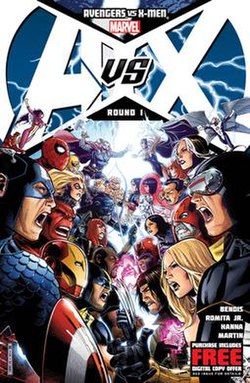
Avengers Vs. X-Men: The Dumbest Superhero Book Ever?


This review is going to contain a lotta spoilers so be warned - if you want to save the crappy surprises for when you venture into this title, skip this review entirely, then come back and agree vigorously with my opinions. 

Back in the 90s, Marvel and Capcom teamed up to create a Marvel Superheroes fighting game; now in 2012, comes the late novelisation of that game. Not really, but “Avengers Vs. X-Men” is essentially the same idea – characters pointlessly brawling with one another.

The book started poorly with an introduction by a WWE wrestler called CM Punk. He incorrectly calls his intro a “forward” instead of a “foreword”; I immediately stopped reading and turned to the story proper.

Anyone saying you “have” to read a ton of X-Men and Avengers books before reading this are probably working for Marvel because you simply don’t. “House of M” and subsequent books like “Messiah CompleX” and “Generation Hope” are interesting to read and set up this story but all you need to know going into this event is that a) Scarlet Witch got rid of almost all the mutants on Earth (less than 200 remain) by uttering a spell at the end of House of M: “No More Mutants”; and b) Hope Summers was the first mutant born after the spell and was subsequently hailed as the Mutant Messiah.

Phoenix - the fiery and all-powerful being that possessed Jean Grey in the “Dark Phoenix Saga” - is returning to Earth because the “creative” directors at Marvel have run out of ideas and are desperately ransacking past, greater storylines for their new books. The vessel Phoenix is going to choose, everyone thinks, will be Hope, the first and only mutant born after Scarlet Witch’s “No More Mutants” curse. Captain America and co. remember the devastation brought about by Phoenix the last time it visited Earth and bonded with Jean Grey, so they are understandably terrified of this happening again. If Hope is to be the new Phoenix, she must die. But Cyclops and co. believe Phoenix’s return will signal the rebirth of the mutant race and undo the damage caused by Scarlet Witch. If Hope is to be the new Phoenix, she must live. And so we have Avengers Vs. X-Men, a massive Royal Rumble of superheroes sparked by an argument about a being nobody fully understands and a possibility nobody knows will happen for sure.

But don’t think about the “plot” and “storyline” too much! This is about fighting! Stare at the colourful characters as they shoot colourful power beams and punch one another in their colourful costumes while gritting their teeth. Wow, Cyclops is fighting Cap! Red Hulk is fighting Thing! Doctor Strange is fighting Magik! And so on…

I did actually find this first cycle of fighting exciting and thought that with the fighting out of the way, maybe this predictable scenario would take a different turn? Then when Hope hits the road, on the run from both sides, and Wolverine joins her, I thought great! Wolverine and Hope going it alone! And then that storyline fizzles out mere pages later and we’re back to the fighting. And more fighting. And more fighting. Until Phoenix arrives, and then more fighting entails. That initial burst of interest had long been eclipsed by the sheer banality of the story and unrelenting tedium of the endless fighting.

Superhero comics are more than just fighting but that’s all this superhero book is: fight fight fight. And despite having a massive cast of characters, all of whom have decades of defined personalities, this book essentially wipes away all traces of them so they’re all monotone dullards. Spider-man (in his brief appearances) doesn’t crack jokes or say anything witty or interesting because all this fighting is all so serious. Iron Man is basically relegated to the side-lines to scientifically figure out how to beat Phoenix (by the way, where’s Reed Richards?) so when he appears he’s talking boring science crap; his charming, roguish personality is entirely absent.

Instead, arguably the two most boring characters in the Marvel U are given centre stage: Cyclops and Captain America. Cap is whiter than white bread and with his no-nonsense manner of speaking is about as interesting: he is practical, dull, and unimaginative, repeatedly yelling “Avengers Assemble!” way too many times. Cyclops has the personality of a brick. When he’s not being told what to do by his girlfriend, he’s whining about mutants being an endangered species for the billionth time, wittering on like a fussy hen and glumly looking into the middle distance. These have got to be the most tedious men to ever headline a superhero comic. Long before this book was over I wanted both of these dudes dead, never to return.

The storyline does get punched up to the next level when Phoenix appears but doesn’t pick Hope to bond with, instead dividing its power amongst Cyclops, Emma Frost, Namor, Colossus, and Magik to become the Phoenix 5 – because Iron Man did some…thing to it. And now they have jazzy new outfits like they stepped from the pages of the last Marvel event, “Fear Itself”. Anyway… remember that Cyclops wanted to use the Phoenix to bring back mutants? That turns out to be the one thing he doesn’t do with the Phoenix power. He does make the world a better place, destroying all guns and weapons and providing free and safe sustainable energy for everyone instead.

In the end, Cyclops follows the obligatory bad guy path to hell even though he was doing well controlling Phoenix until the Avengers kept showing up and fighting him. The ending is forced and contrived, predictably ending in a fight and once more using Scarlet Witch’s ridiculously over-powerful ability, emphasised by Hope, to cast out Phoenix (until Marvel need it for another event story) and then, for no reason, every mutant whose powers were taken by Scarlet Witch at the end of “House of M” has them returned.

It should also be pointed out that Cap does a complete 180 on his original plan for no reason. Initially he wanted to stop Hope from having contact with Phoenix as he was certain she would be unable to control it leading to the destruction of everything. But by the end, he has no problem with her becoming the Phoenix! She has literally done nothing to warrant this sudden trust but he’s ok with it anyway. If he would’ve just taken a minute and thought about it at the start then this whole AVX storyline could’ve been avoided. Especially as it doesn’t seem like Phoenix did anything terrible to Earth – got rid of weaponry, check, produced free, safe and renewable energy for all, check. It’s not until the Avengers start trying to kill the Phoenix 5 that things go wrong. I guess I’m saying Cap’s reputation as a strong, thoughtful leader is totally unjustified and he is in fact a complete and total incompetent.

My edition was the mammoth 568 page hardback. After the Avengers Vs. X-Men #0-#12 main issue story arc comes the #1-#6 AVX issues which are just fights. At least with the main storyline there are respites from the fighting to attempt including some sorely needed elements like dialogue, ideas, character and plot development (despite none of these things being effectively pulled off); with AVX, it’s just fighting. So we get some arbitrary fights with Iron Man Vs Magneto, Magik Vs Black Widow, Namor Vs Thing, and so on. These are fights that are supposed to be happening in the main story but were separate to keep that story from slowing down. It was with AVX that I realised why Marvel had asked a WWE wrestler to intro this book – these fights were the comic book equivalent of WWE wrestling: staged, colourful, and meaningless.

Finishing off this book is Infinite Comics #1, #6 and #10. Infinite was created for the sole purpose of reading comics digitally on tablets, which is a great idea. Content-wise, these comics rehash the events already gone over in the main story arc but with added pages that don’t improve the story. Consequently, like AVX, Infinite feels like an unnecessary add-on.

And speaking of unnecessary add-ons, you may be wondering what the “AR” boxes appearing on every other page in the book mean - “Augmented Reality” is another innovative feature by Marvel to integrate interactive content into their comics. Because when I read comics, I always think, this is good but what I really want when reading is to watch video. It’s a strange idea to insert video of artists informing the reader how they came up with a particular design choice for the panel but how interested are you in hearing about that really? It depends on the reader but I’m not one of those who needs to know everything about the creation of a comic. Also, I read to read – I’m not some ADHD kid who needs to flick from reading to watching video and back again every few panels.

Also, Xavier dying is becoming kind of a cliché at this point. He died in Grant Morrison’s “New X-Men”, he died in “Messiah CompleX”, he died in this book. It’s not at all affecting knowing that the character who died in this book has died many times before and Marvel has had no compunction in bringing him back to life. It seems almost pointless of them to shoehorn in his death (to give their story more emotional weight perhaps) but all it does is underline how pointless this entire story is. While the rule is that no-one is gone forever in Marvel except for Spider-man’s Uncle Ben, the stories should at least be entertaining – fail that, and you fail big. And this book fails.

It’s odd that this would be the case. Some of the best comics writers working today worked on this book. Jason Aaron, one of my favourite comics writers, has written a great run on Wolverine and is working on the even better Wolverine & the X-Men title; Ed Brubaker wrote one of the most acclaimed Captain America books ever; Jonathan Hickman’s doing stellar work on FF and Fantastic Four; and Brian Michael Bendis, whose work on Ultimate Spider-man, Marvel’s flagship character, speaks for itself: 12 years of first class writing and counting, his stewardship of that character has been invaluable to Marvel and readers alike. And yet, all of them worked on this book and all of them failed to create an interesting story. Too many cooks in the kitchen maybe? But it makes me think that maybe it’s not just the writers who should be blamed for this awful book but the dodgy creative direction at Marvel who steered this book into such unfathomably crap waters. Either way, despite this book having enormous talent attached, it is a massive artistic failure.

So another year, another lacklustre Marvel Comics event. “Avengers Vs X-Men” is for those who enjoy WWE wrestling and like to play with gadgets and watch videos rather than read a comic straight through. This book is dumber than Lou Ferrigno’s pants. It’s also for people who don’t care much about anything related to good storytelling, like character development, memorable scenes and dialogue, and good writing – just superheroes punching one another. This review is already too long so I won’t go into the many plot holes the flimsy premise of this book rests upon but suffice it to say “Avengers Vs X-Men” is a cynical, contrived, bloated mess of a book that, despite its immense bluster, is ultimately a very small, piecemeal story with forgettable moments offering nothing of substance.

If someone tells you this is a good book and is worth reading, be very suspicious. Chances are they’re waiting for you to fall asleep somewhere around the 300th page and umpteenth consequence-free fight, then steal your kidneys. But I’d wake up! you say. Oh no - reading this boring book is far more potent than camphor. You won’t awaken until it’s all over. To re-iterate: read this and you will lose your kidneys to the black market and die. To avoid this inevitable fate, stay far away from “Avengers Vs. X-Men”. But who wins? you ask, the Avengers or the X-Men? Nobody wins, you poor soul. We all lose by reading this.


Avengers Versus X-Men